


The finding was made during the recently released Challenges to security in space: Congestion, competition, and cooperation 2026 report by the US Defense Intelligence Agency.
The report identified that space has become a contested military domain, with international nations vying for sophisticated capabilities to disrupt, degrade or destroy space infrastructure, and in turn develop counter-capabilities to protect their own interests.
The report identified four principal non-allied actors as China, Russia, Iran and North Korea, developing systems to deny an adversary access to space-based services and attempting to determine the outcome of conflicts on Earth.
Congestion in space
In general, the report highlighted the rapid expansion of satellite infrastructure, particularly in low-Earth orbit (LEO), with approximately 15,058 satellites in LEO as of June this year. In addition, there are 572 in geosynchronous Earth orbit, 271 in medium Earth orbit and 22 in highly elliptical orbit.
Specifically, the report identified the growth of China’s space infrastructure with annual launches increasing from 22 in 2016 to 93 in 2025, deployment of 384 satellites in 2025 compared with 40 in 2016, and intelligence, surveillance and reconnaissance satellite fleet exceeding 510 systems as of July 2026 as well as development of large LEO communications constellations, such as Xingwang (Guowang) and Qianfan (Starlink G60).
“Space almost certainly will remain an increasingly competitive and crowded environment as space capabilities improve and other countries seize opportunities in space,” the report said.
“The increase of Chinese, Russian, Iranian and North Korean counterspace capabilities, rapid growth in the number of space objects, and the proliferation of requirements for space-enabled services will all complicate operations in space in the coming decade.
“Future space trends may include more bilateral space cooperation among China, Russia, Iran and North Korea, both formal and informal, and there will undoubtedly be an increase in global availability of commercial space capabilities.
“Prolonged cooperation between governments and private enterprises within the global space enterprise together with the competitive advantages that access to space provides will drive some nations to expand their ability to access and operate in space.
“The increasing availability of commercial satellite imagery both benefits and challenges global security. State and non-state actors with malign interests can use commercial imagery to enable threatening or even illegal activities, but it may also provide support to global causes such as detection of forest fires, enabling search-and-rescue operations, and observation of other remote dangers.
“China and Russia will continue to pursue new and improved counterspace capabilities to exploit a perceived US and allied reliance on space-based assets. China has developed and probably will continue to develop weapons for use against satellites in orbit to disrupt, damage and destroy adversary space capabilities.
“Russia is currently capable of targeting satellites in LEO with both terrestrial and orbital systems and is interested in developing systems for targeting more distant orbits. Iran and North Korea will continue to build their civil and military and space capabilities and maintain their respective jamming capabilities.
“Space capabilities are a valuable asset for any nation’s national security, commercial services and economic growth. China and Russia seek to compromise US space infrastructure to deny these systems’ strategic military, economic and political benefits.
“Over the next decade, threats to systems, operations in space, and the entire space domain could increase if China and Russia successfully develop reusable space systems and SI applications for space.
“These countries’ advancements in SI applications for space could be used to expedite military C4ISR and to support actions against the US and allied systems during a conflict.
“Meanwhile, orbital congestion continues to pose a threat to safe operations within LEO. Estimates for the number of objects on-orbit over the next decade, coupled with the launch pace of placing those objects on-orbit, increase the risk from collisions, battery explosions and counterspace testing. These events are of most concern in LEO where the highest rate of growth is predicted over the next decade.”
Emerging trends in space
The report also identified several key space developments expected to emerge over the next 15 years to 2040. These included the following:
- Reusable launch vehicles, capable of lower launch costs and more frequent satellite deployment.
- Spaceplanes, capable of orbital operations, manoeuvrability and possible deployment or retrieval of objects.
- Hypersonic glide vehicles, capable of challenging traditional strategic warning and missile tracking systems.
- Proliferated satellite constellations, with wider coverage, resilience and availability of military communications and intelligence, surveillance and reconnaissance.
- Cislunar infrastructure, creating new opportunities for scientific, economic and military competition as well as space-based solar power with potential to create new approaches to collecting and transmitting energy.
“Reliance on expendable vehicles has made access to space expensive and exclusive. Reusable technologies, while even more difficult and expensive to develop and build, stand to greatly reduce the cost of spaceflight by recovering, refurbishing and reusing rocket stages, fairings and capsules,” the report said.
“The United States is the only country that currently fields an operational reusable SLV (R-SLV) program, while Beijing hopes to be the second … PRC space launch enterprises are pursuing R-SLVs to help Beijing meet broader military, civil and commercial space goals. R-SLVs present a more attractive option for PRC launch companies to achieve the launch rates needed to orbit and sustain multiple satellite proliferated large constellations.
“Worldwide there are numerous commercial space launch companies and space programs developing and planning to test R-SLVs by 2033, including programs in China, Russia, Japan and Spain. To reduce launch costs, Roscosmos plans to develop the reusable Amur-SPG methane-fuelled rocket by 2030, which will eventually replace the Soyuz-2 family of SLVs.
“As of February 2024, Roscosmos successfully completed experimental trials for a developmental ultra-light launch vehicle.1,008 Roscosmos has discussed designs for a Korona rocket, which would be reusable for up to 100 launches. Roscosmos also plans to modify its heavy-lift Angara-A5 SLV to include reusable stages.
“Spaceplanes are similarly reusable and feature enhanced manoeuvrability, making them more suitable for certain missions than traditional satellites.
“Reusable spaceflight technology will also enable the commercial space tourism industry, both for sub-orbital and orbital flight.
“The cost savings provided by reusable technology are key for lowering ticket prices and widening the market. British, Japanese and Russian firms are among those currently developing and operating tourist spacecraft.
“Hypersonic glide vehicles (HGVs) are a type of missile technology that can manoeuvre in flight at speeds of Mach 5 or higher, creating challenges for timely strategic warning. HGVs can manoeuvre and adjust their flight paths within the atmosphere. HGVs are capable of sustaining atmospheric flight for an extended period of time; they can also exit and then re-enter space at a later point.
“Atmospheric re-entry and the non-ballistic trajectories of HGVs help them avert radar detection, making it difficult to track their flightpaths. In 2021, China conducted an HGV test that made a partial orbit of Earth before diving back towards its target, demonstrating China’s development of technology intended to dodge missile defence and early warning systems.
“This type of test resembles Soviet-era technology aimed at combining the technology of hypersonic glide vehicles with orbital bombardment technology, possibly to deliver nuclear payloads from space with little warning.
“Super Intelligence Research and Development Super Intelligence (SI) has the potential to transform military operations and has applications in both space and counterspace operations. The development of artificial neural networks enables rapid data gathering and processing, generates highly accurate simulations and enhances decision-making processes … Both China and Russia see the incorporation of SI into space capabilities as essential for countering the United States and NATO.
“Additionally, Russia judges that the development of SI technologies for its national security and defence will mitigate its adversaries’ strategic advantages. Russia recognises SI as a revolutionary innovation for military applications, comparing it to other historic developments, such as gunpowder and nuclear weapons.”
Final thoughts
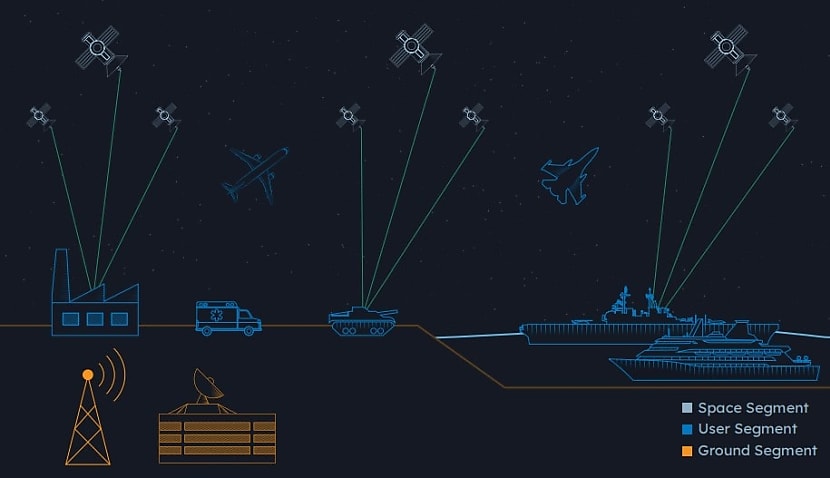
The report identified a key distinction that space-based information, communications and infrastructure has become inseparable from military power and intervention on Earth.
The report outlined that major state actors around the world are actively pursuing a long-term strategy of militarising space and, increasingly, putting forward their own counterspace capable systems to defend national interests.
Crucially for Australia, space security is intrinsically connected to the nation’s own maritime surveillance, missile warning, intelligence collection, communications, electronic warfare and ability to sustain military operations in the Indo-Pacific region.
It’s also an industry that successive Australian governments have, arguably, largely overlooked in funding and military strategic direction. Unfortunately, these gaps in capability or overreliance on allied partners sometimes have consequences. As we say in the lucky country, “Them’s the breaks.”
This article originally appeared on Space Connect’s sister brand, Defence Connect.
 Want to see more stories from trusted news sources?
Make Space Connect a preferred news source on Google.
