


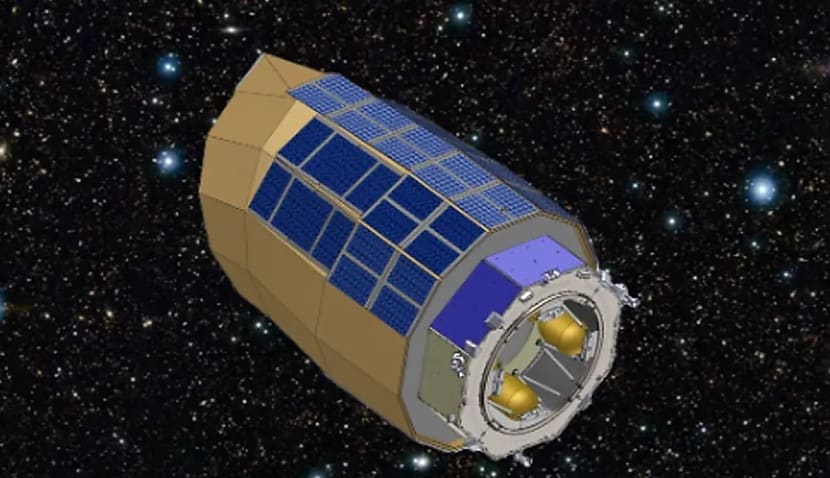
Designed to be larger than the venerable Hubble Space Telescope, the Schmidt Sciences is expected to be launched by the end of the decade, delivering rapid, highly precise astronomical observations across a wide range of scientific fields.
Co-founder of Schmidt Sciences and wife of Eric Schmidt, Wendy Schmidt, told Scientific American, “For 20 years, Eric and I have pursued philanthropy to seek new frontiers. With the Schmidt Observatory System [which includes Lazuli], we’re enabling multiple approaches to understanding the vast universe where we find ourselves stewards of a living planet.”
At the heart of the observatory is an off-axis, freeform telescope design that produces diffraction-limited image quality across visible to near-infrared wavelengths, spanning roughly 400 to 1,700 nanometres.
This optical system feeds a wide, flat focal plane and delivers exceptionally sharp images, achieving a Strehl ratio greater than 0.8 at 633 nanometres; this level of performance allows Lazuli to support demanding observations across multiple instruments simultaneously.
Lazuli carries three complementary scientific instruments, each optimised for a distinct but interconnected role. The wide-field context camera provides multiband imaging over a large field of view, measuring approximately 35 by 12 arcminutes.
It is designed for high-cadence photometry, enabling astronomers to track how objects change in brightness over short timescales and to place transient events in their broader astrophysical context.
The integral field spectrograph offers continuous spectroscopic coverage across the full 400–1,700 nanometre bandpass, at moderate spectral resolution.
By capturing spatially resolved spectra, the instrument allows scientists to measure how light varies both across an object and across wavelength, supporting stable and precise spectrophotometry for studies of stars, galaxies and transient phenomena.
The third instrument, the ExtraSolar Coronagraph, is focused on high-contrast imaging. It is designed to suppress the overwhelming glare of stars to reveal faint nearby objects, particularly exoplanets.
The system is expected to achieve extremely deep contrast levels, reaching raw contrasts of around one part in 100 million and approaching one part in a billion after data processing. This capability places Lazuli at the forefront of direct exoplanet imaging and atmospheric characterisation.
Stuart Feldman, an astronomer, computer scientist and president of Schmidt Sciences, also speaking to Scientific American said, “This is the first full-scale observatory that is privately funded in space.”
A defining feature of Lazuli is its operational agility, with the observatory to operate from a lunar-resonant orbit with a three-to-one resonance, enabling efficient sky access and stable observing conditions.
From this orbit, Lazuli is designed to respond to targets of opportunity in less than four hours. This rapid response capability is a core program requirement and represents a step change in temporal flexibility for a space telescope of this size, allowing routine follow-up of fleeting or unpredictable cosmic events.
The observatory’s technical design is shaped around three broad science themes. The first is time domain and multi-messenger astronomy, including the identification and characterisation of counterparts to gravitational wave events and other fast-evolving transients.
The second focuses on stars and planets, particularly the direct imaging and spectroscopic study of exoplanets and their atmospheres. Finally, the third area is cosmology, where Lazuli will contribute to precision measurements such as Type Ia supernova observations used to probe the expansion of the universe.
Feldman stressed, “We’re not replacing NSF or NASA or the European agencies. We’re trying to fill in areas that they really aren’t designed for and invest in that.”
While these science priorities guide the design, Lazuli is intended to operate as a general-purpose observatory. A significant portion of observing time will be open to the global astronomical community, enabling a broad range of investigations beyond the core themes.
The current concept outlines the observatory’s architecture and capabilities at a preliminary design stage. The program is planned around a rapid development cycle, with the aim of moving efficiently from concept to launch and into science operations, delivering a powerful and flexible new asset for space-based astronomy.
 Want to see more stories from trusted news sources?
Make Space Connect a preferred news source on Google.