


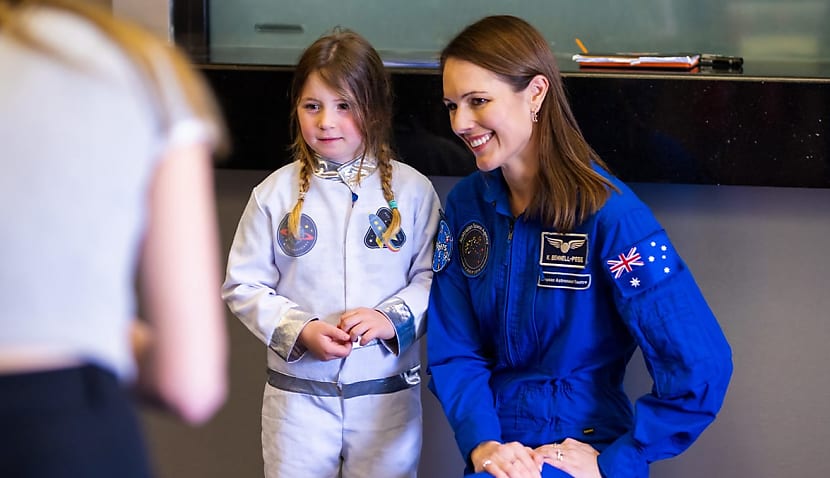
The campaign, which brings together universities, industry leaders, chief scientists, STEM (science, technology, engineering and mathematics) organisations and senior political figures, has mounted a rare, cross-sector push to deepen Australia’s engagement with the global space economy.
Central to the proposal is a strengthened partnership with the European Space Agency (ESA), potentially including an Australian astronaut flying on a future ESA mission.
Last month, the coalition submitted nearly 80 letters of support to the prime minister and senior cabinet ministers, signalling broad national backing for greater participation in human spaceflight. Advocates said the timing is critical, with ESA member nations currently negotiating mission allocations and industrial contracts that could shape the sector for decades.
Danail Obreschkow, director of the International Space Centre, described the opportunity as “once in a generation”.
“The window for Australia to secure a human spaceflight mission that delivers continuing economic and technological benefits is extraordinarily narrow,” Obreschkow said.
He stressed the proposal extended far beyond the symbolic act of sending an astronaut into orbit.
“This is about anchoring Australia to the global space economy,” he said. “Nations that participate in human spaceflight sit at the table where future space rules, supply chains and collaborations are shaped.”
The global space economy is now valued at nearly US$900 billion and growing rapidly, driven by satellite services, advanced manufacturing and commercial launch capabilities. Australia, one of the world’s most space-dependent nations, relies heavily on satellites for banking, agriculture, telecommunications, logistics, disaster response and national security.
Despite this dependence, Australia remains in the early stages of developing sovereign space capability through organisations such as the Australian Space Agency and research institutions nationwide.
Supporters argue participation in a human spaceflight mission would accelerate domestic industry growth, unlock new international contracts and expand access to advanced research and manufacturing opportunities.
They also point to the potential to inspire future generations of engineers, scientists and technicians.
Megan Clark, former head of the Australian Space Agency and former chief executive of the CSIRO, said the national impact could be profound.
“Imagine Australians across the country counting down and holding their breath for lift-off, wishing a fellow Australian a productive journey and safe return,” Clark said.
“Imagine a generation of schoolchildren watching an Aussie perform experiments in space. Human spaceflight challenges Australians to master the hardest problems in front of the world.”
Campaign leaders said the investment required from the Commonwealth would be modest compared with the potential returns, including new export opportunities, high-value manufacturing jobs and deeper integration into global supply chains.
The initiative is supported by key figures across academia and industry, including representatives from the Space Industry Association of Australia, Engineers Australia, and space consultancy Indo-Pacific Space.
Advocates argue that while Australians face immediate cost-of-living pressures, strategic investment in advanced industries such as space will be essential to drive future economic growth, national capability and technological sovereignty.
With international mission slots and contracts now being allocated, supporters warn that Australia must act quickly or risk being left behind in one of the 21st century’s most strategically significant industries.
 Want to see more stories from trusted news sources?
Make Space Connect a preferred news source on Google.