


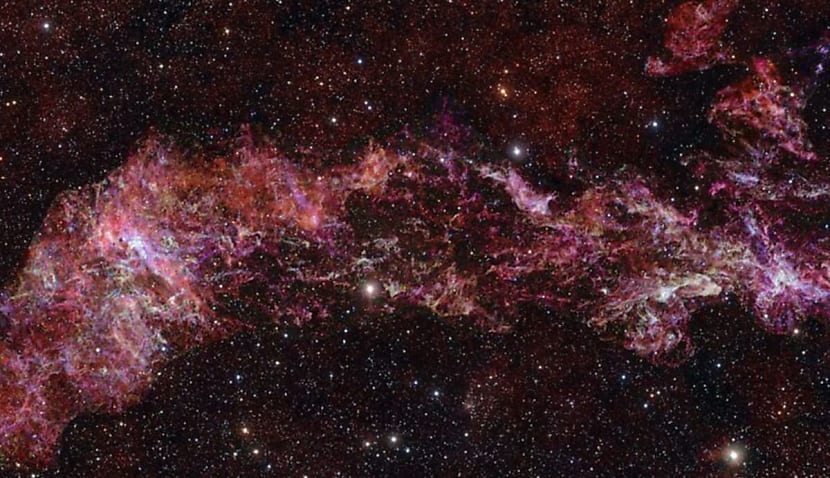
Researchers from the Australian National University were part of an international collaboration that mapped more than 650 light years of the galaxy’s inner region, an area packed with dense clouds of gas and dust that are normally hidden from view.
The record-breaking image was captured using the Atacama Large Millimeter/submillimeter Array (ALMA), a powerful network of radio telescopes located in northern Chile that allows astronomers to observe extremely cold gas deep within space.
The image focuses on the turbulent environment surrounding Sagittarius A*, the supermassive black hole at the centre of our galaxy.
According to the international research team, the region is one of the most extreme environments in the Milky Way, where dense gas clouds collide, twist and collapse to form new stars.
“It’s a place of extremes, invisible to our eyes yet now revealed in extraordinary detail,” said Dr Ashley Barnes from the European Southern Observatory in Germany.
Australian astrophysicists played a major role in interpreting the new data. Professor Christoph Federrath, from the Australian National University, said the observations provide a unique look at the raw material that fuels star formation.
“The gas that ACES is targeting is cold molecular gas – the raw fuel from which stars form and that ultimately powers them,” Federrath said.
The observations form part of the ALMA CMZ Exploration Survey (ACES), which is mapping the Central Molecular Zone, the dense band of gas that encircles the galaxy’s core.
For Australian researchers, the Milky Way’s centre offers a rare laboratory for studying extreme astrophysical conditions.
“It is the only galactic nucleus close enough to Earth for us to study in such fine detail,” Barnes said.
The survey has produced the largest image ever assembled using the ALMA telescope array.
The final mosaic was created by stitching together hundreds of individual observations, forming an enormous cosmic panorama that spans a section of sky roughly equivalent to three full moons placed side by side.
The resulting dataset reveals the Central Molecular Zone at every scale, from massive gas structures stretching tens of light years across to small, dense clouds forming around newborn stars.
While star formation in the outer regions of the Milky Way is relatively well understood, conditions near the galactic centre are far more violent.
According to ACES project leader Steve Longmore from Liverpool John Moores University, the region produces some of the most massive stars in the galaxy.
“These stars live fast and die young in spectacular explosions called supernovae or even hypernovae,” Longmore said.
One of the key goals for Australian researchers is understanding the powerful turbulence that dominates the gas clouds near the galactic centre.
Federrath said the chaotic flows of gas and dust are far more intense than those seen in typical star-forming regions.
“Near the Galactic Centre, this turbulence becomes extreme, weaving a dense, tangled web of filaments that ultimately collapse to form new stars,” he said.
Despite decades of research, astronomers still do not fully understand what drives this turbulence.
By combining the new observational data with advanced supercomputer simulations, ANU scientists hope to uncover the physical processes that shape star formation in such hostile environments.
“By combining cutting-edge supercomputer simulations with observational datasets like ACES, we can finally begin to unravel the mysteries of the extreme, chaotic conditions under which stars are born,” Federrath said.
The research is detailed in a series of scientific papers published in Monthly Notices of the Royal Astronomical Society, with the full dataset to be released through the ALMA Science Portal.
The ACES collaboration involves more than 160 scientists from over 70 institutions across Europe, the Americas, Asia and Australia, highlighting the growing role Australian astronomers play in major international space research projects.
 Want to see more stories from trusted news sources?
Make Space Connect a preferred news source on Google.