


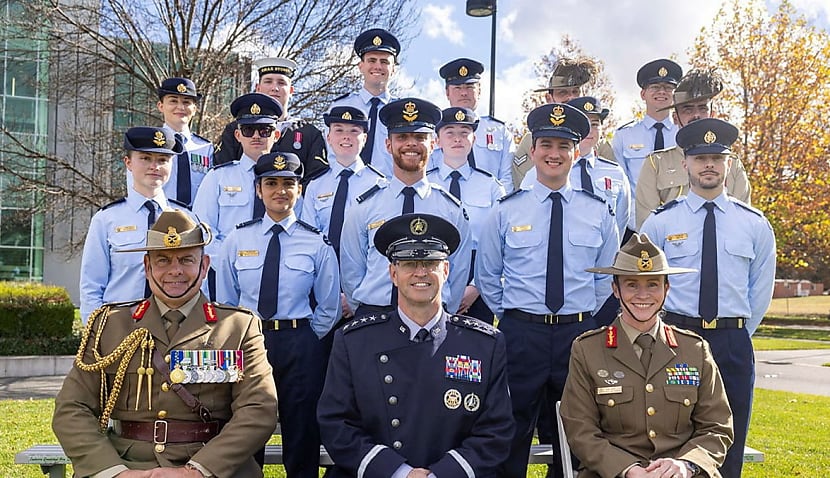
From the bridge of a Hobart Class destroyer to the control rooms of Australia’s growing space enterprise, a diverse group of sailors, soldiers and aviators have become the first graduates of the Australian Defence Force’s inaugural Space Initial Employment Training (IET) course, marking a significant milestone in the evolution of space as an operational domain.
Conducted between 28 January and 14 May, the course saw 16 personnel from across the Australian Defence Force undertake intensive training designed to prepare them for operational roles in the space domain.
Participants were challenged to make decisions in complex, information-saturated environments, learning how to transform large volumes of technical data into clear operational outcomes. Through a combination of classroom instruction, practical exercises and team-based assessments, graduates developed the skills required to support Defence operations across all domains.
Among them was Able Seaman Mark Rogers, who transferred into the space operations specialist employment category after six years in the Royal Australian Navy as an electronics technician working on Aegis SPY radar systems aboard Hobart Class destroyers.
While some aspects of his previous role provided a useful foundation, the transition to space operations introduced an entirely new set of challenges.
“Some of the skills I learned over the past six years transfer across to space, but there are also a lot of new concepts to learn,” he said.
AB Rogers’ fascination with space began when he was 12 years old, inspired by documentaries on the Discovery Channel. What started as a childhood interest eventually became a long-term career ambition.
One of the most demanding elements of the course was orbital mechanics, a subject he described as mathematically challenging but fundamental to understanding how satellites behave and operate.
Unlike his previous role maintaining complex systems, space operations focuses on gathering and analysing information to support joint operations across Defence.
“We’re mainly operating and gathering information to support cross-domain missions, rather than maintaining the systems,” he said.
Now preparing to enter the operational workforce, AB Rogers is eager to apply his new skills as Australia’s space capabilities continue to expand.
“I’m very excited to use the systems and continue to learn and expand my space operations knowledge,” he said.
“Space is very big, and there’s a lot to learn. It’s also growing rapidly as an operational domain.”
Flying Officer Nandini Rajpurohit was among the officer graduates of the course and has since moved into an operational role with No. 1 Space Surveillance Unit following a posting to Air Force Headquarters as a personnel capability officer.
With academic qualifications in computer science, mathematics and statistics, the transition to become a space operations officer was a natural progression. Her interest in the field was first sparked through STEM activities and later strengthened when she helped establish a space club during her time at university.
She believes the strategic importance of space extends well beyond any single service.
“Through space, you can essentially protect and support all the other domains,” she said.
“It’s not service-centric, it’s truly joint.”
The course placed officers in demanding scenarios requiring them to process large volumes of technical information, make timely decisions and adapt to rapidly changing circumstances.
“Because of how unpredictable things are and how fast technology develops, we need to be ready to adapt,” FLGOFF Rajpurohit said.
The Army was equally well represented among the inaugural graduates. Warrnambool-born Corporal Dion Caskey and Trooper Jake Lenehan both made the transition from armoured cavalry backgrounds into the emerging space workforce, highlighting the increasingly diverse pathways into Defence’s newest operational domain.
For CPL Caskey, the decision to transfer into space operations followed nearly 12 years as a tank crewman and was influenced in part by his partner, who already worked within the space community.
“I didn’t realise there was a whole domain that was going to emerge all of a sudden,” he said.
“Seeing that role gave me a different insight into options for my career and made me want to move into it.”
Throughout the course, students developed a detailed understanding of orbital mechanics, including Newton’s and Kepler’s laws, and how these principles govern satellite movement and operations.
“Understanding how spacecraft move, rather than just watching it, was really cool,” CPL Caskey said.
The training also opened his eyes to the critical role space plays in modern military operations and national security.
“I didn’t realise how significant space was to Defence, Australia and globally. It’s one of the first things affected during conflict.”
Trooper Lenehan arrived at the course after 11 years as a cavalryman, including service as an ASLAV gunner. His first exposure to space operations came during a posting with the Joint Commercial Operations team in Adelaide, where he gained an appreciation for the growing importance of space capabilities.
A change in personal circumstances prompted him to seek a new challenge while remaining in Defence.
“I never saw myself doing this,” he said.
“It wasn’t really a thing when I first joined the cavalry.”
For Trooper Lenehan, the move represented a significant shift from traditional land warfare to a highly technical and rapidly evolving field.
“On the course we started with the basics, understanding how objects move in space, then built into capabilities and how we integrate with the other domains,” he said.
The course culminated in a capstone exercise that required participants to plan and coordinate space operations as a distinct operational domain while simultaneously supporting activities across land, sea, air and cyber.
Now posted to No. 1 Space Surveillance Unit, Trooper Lenehan will help operate remote sensing systems that track and monitor objects in orbit, contributing to Australia’s Space Domain Awareness capability through the use of Australian and allied sensors.
“We’ll be operating telescopes and radar to track space objects and build space situational awareness,” he said.
“Seeing how fast things move in space, trying to visualise that, is just phenomenal.”
The inaugural Space Initial Employment Training course reflects the growing importance of space to modern military operations.
As Defence continues to expand its space capabilities, graduates such as Rogers, Rajpurohit, Caskey and Lenehan represent a new generation of specialists drawn from across the Navy, Army and Air Force, united by a common mission: ensuring Australia can understand, operate and compete in an increasingly contested domain that underpins every aspect of contemporary warfare.
 Want to see more stories from trusted news sources?
Make Space Connect a preferred news source on Google.