


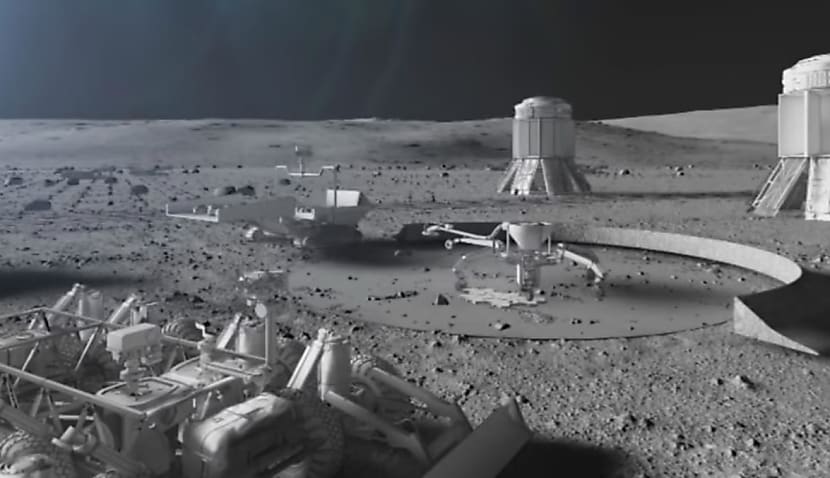
Albert Rajkumar, a space architecture researcher at the University of Adelaide’s Andy Thomas Centre for Space Resources, is investigating whether components such as bricks and modular units should be considered active participants in the construction process, rather than passive elements.
“In most discussions around lunar construction, humans and robots are key, with humans interpreting, supervising and intervening, while robots execute the task,” Rajkumar said. “But I’m currently exploring the idea that the building block, like a brick, is not a passive part of the process, but an active agent in construction.”
Rajkumar said the challenges of building on the moon go beyond automation, particularly because human operators will not be physically present alongside robotic systems on-site.
“That poses new challenges. But it’s where extended reality (XR) can help reconnect human perception and decision making with robotic construction happening at a distance,” he said.
He added that future progress will depend just as much on understanding material behaviour as it does on advances in robotic autonomy, artificial intelligence and user interface design.
Rajkumar has published several papers on the concept, including work presented at last year’s International Astronautical Congress held in Sydney, which examined how humans, robots and construction materials might interact in off-Earth environments.
He recently tested these ideas through a hands-on demonstration at the Australian Rover Challenge at the University of Adelaide’s Roseworthy Campus, as part of his “Side Quest” project.
Participants wore virtual reality headsets and, while immersed in a simulated lunar environment, were tasked with supervising a robotic arm assembling structures from a set of blocks placed on a table behind them.
“Taking on the role of a supervisor, players worked with a real robotic construction system to build the tallest tower possible while immersed in a VR lunar habitat setting,” Rajkumar said.
The experiment was designed to showcase how robotics and extended reality could be combined for construction tasks, and to highlight the evolving relationship between human decision making, machine execution and material behaviour.
He said the Rover Challenge provided an ideal platform to engage students and researchers working across robotics, artificial intelligence, machine learning and XR, with ongoing efforts to build further collaborations.
Looking ahead, Rajkumar is preparing to scale up the experiment using a more life-sized habitat structure within the CRATER facility at Roseworthy.
“In the long term, we hope this research helps lay the groundwork for how humans and robots might build together – both in space and here on Earth – and helps us understand what this new form of architecture might look like,” he said.
 Want to see more stories from trusted news sources?
Make Space Connect a preferred news source on Google.