


The early activation of elements of the Deep Space Advanced Radar Capability (DARC) marks a significant step forward in joint efforts to monitor and secure space, particularly in geosynchronous orbit where critical military and commercial satellites operate.
Designed as a trilateral initiative between the United States, Australia and the United Kingdom, the system will ultimately provide continuous, all-weather tracking of objects in deep space, significantly improving detection, identification and characterisation capabilities.
Officials said bringing the capability online earlier than planned demonstrates both the urgency of the mission and the growing integration between allied space forces.
The development comes as senior leaders emphasise the unique strategic value of the US–Australia partnership in space. One senior Space Force leader noted that “part of the great strength” of the service lies in its close collaboration with allies, particularly Australia and the United Kingdom.
That cooperation delivers a critical operational edge, with the geographic spread of the three nations enabling near-continuous global surveillance of the space domain.
Lieutenant Colonel Derek Haun, 20th SPSS commander, explained the importance of this collaboration between the three partners, saying, “Coordination with our allies, as well as our US Space Force teammates in Space Systems Command, has enabled our team at the 20th Space Surveillance Squadron to prove the value of the DARC initiative.”
Australia’s role is particularly significant, with its southern hemisphere location providing coverage gaps that cannot be filled by northern hemisphere systems alone. The DARC network is expected to link sites across all three countries, creating a globally integrated sensor architecture.
The program reflects a broader push to deepen interoperability between allied space forces, including shared systems, joint operations and embedded personnel across units.
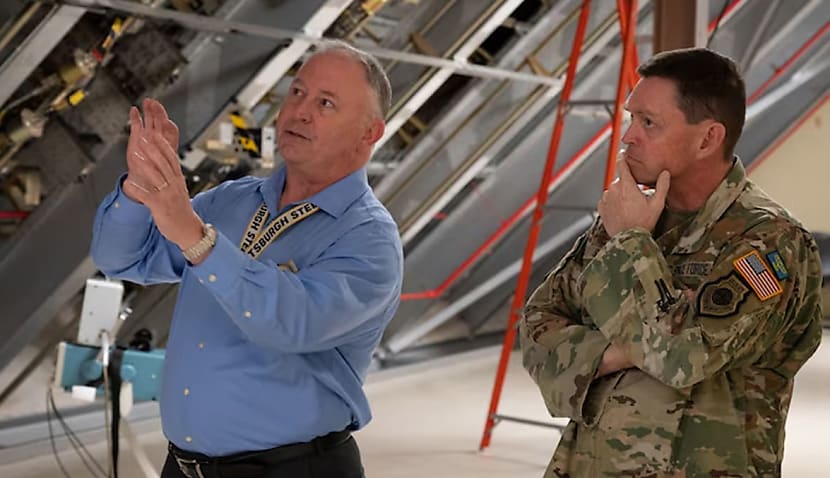
US Chief of Space Operations General Chance Saltzman, during a recent visit to 20th Space Surveillance Squadron (SPSS), said: “The Space Force is all-in on delivering capabilities as soon as they provide a warfighting advantage and then upgrading them as we learn from real-world operations.”
Space domain awareness, the ability to track and understand activity in orbit, has become a central pillar of modern defence strategy, particularly as space becomes more congested and contested.
US officials have previously stressed that the capability is “foundational to responsible space operations” and essential for responding to both routine and hostile activity in orbit. “Part of the great strength of the United States Space Force is our partnership with Great Britain and Australia, because between the three of us, it gives us a geographic advantage that our adversaries do not enjoy."
Lieutenant General Gregory Gagnon, commander of the US Space Force Combat Forces Command said: “We’re at another dynamic point in the history of warfare where the air is no longer the high ground. Space is the high ground.”
With further radar sites planned and additional upgrades expected over the coming years, the US–Australia space partnership is set to play an increasingly central role in maintaining security in what many now describe as the “high ground” of modern warfare.
LTGEN Gagnon added: “Here in Australia, there is a high-powered telescope that is used to sense what’s in space, and it’s not used to look at stars. It’s used to look at satellites.”
 Want to see more stories from trusted news sources?
Make Space Connect a preferred news source on Google.