


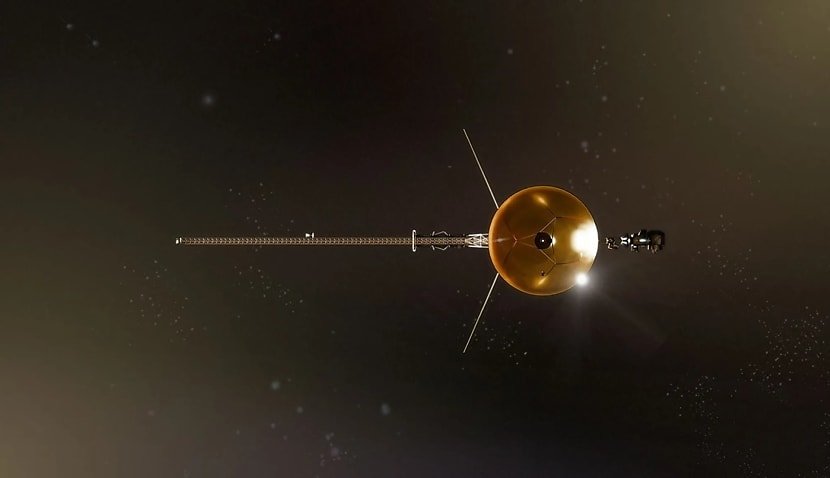
Voyager 1 was originally launched nearly 50 years ago in 1977 to explore space beyond the sun’s protective bubble and is the most distant human-made object. Any light from Earth would take 24 hours to reach the spacecraft.
Voyager 1 and Voyager 2 are considered to be the only two spacecraft to have left the sun’s protective bubble, with Voyager 1 reaching the interstellar boundary in 2012 while Voyager 2 reached it in 2018.
“This is a multigenerational mission. The original generation of the Voyagers, they did the best they could. They stewarded it well, and then they handed it off. I mean, it’s neat when an object is just a light-day away that we made, but an object that can send us a signal back; it can talk to us, that’s incredible. And I see this as an exciting culmination of all that and a good reason to celebrate,” said Princeton University research scientist Jamie Rankin, speaking on NASA’s Curious Universe program.
“The Voyagers gave the first opportunity to really test (theories regarding) … the different boundaries were theorised in the sixties, but it took a while to get there, to actually see them.
“One of the big surprises was that when Voyager 1 crossed the heliopause, they expected a sudden change in the magnetic field direction to be aligned with interstellar space. And what they found instead – and now that both Voyagers have crossed – they’ve found that the magnetic field out there, which is comes in at an angle with respect to the solar system, basically, that actually squishes in our heliosphere and kind of creates a slightly asymmetric shape.
“But I think also we just didn’t know what the medium really looked like until we got there. People had some ideas about what the density would look like far away, and what maybe the magnetic field like would look like far away, but that’s different than what the Voyagers are measuring.
“There’s been new missions developed to image the size and the shape of our heliosphere. They’re getting kind of the two-dimensional mapping view, the aerial view, whereas the Voyagers are taking the road trips through the solar system in both time and space, and so it’s been an exciting time to put this picture together of what is the sun doing out there.
“(If) you can imagine Voyager being on a distant shore. It’s not so far away that we don’t see ripples from the effects of solar activity. We do see just every so often signs of the disturbances from our heliosphere that can survive all the way out. Coronal mass ejections, blasts of materials from the sun that create space weather – those can merge along the way, and they can send ripples that that disturb interstellar space. And Voyager does see that, which is pretty amazing.
“The presence of the sun is felt out there at a light-day away. But in terms of all the gas and the surrounding environment that Voyager is in, it just comes from totally different origins than our sun and the way it modifies everything.”
 Want to see more stories from trusted news sources?
Make Space Connect a preferred news source on Google.
