


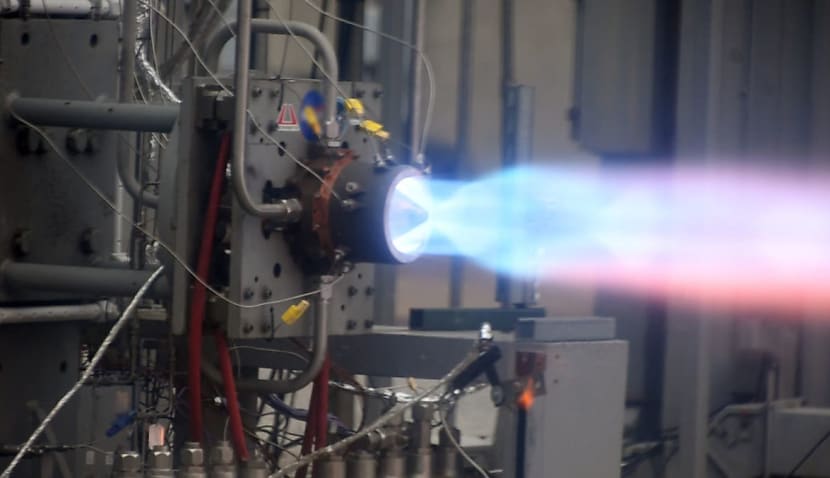
The company confirmed it had completed a series of hot fire tests of its “Chakram” engine at NASA Marshall Space Flight Center in Alabama, with two prototype engines racking up more than 470 seconds of total run time without any visible damage.
The testing campaign included a continuous 300-second burn, believed to be the longest ever achieved for this type of engine, marking a significant step forward for rotating detonation rocket engine (RDRE) technology.
Each engine generated more than 4,000 pounds of thrust, placing Chakram among the most powerful rotating detonation engines demonstrated to date. Aside from a pair of brief igniter trials, every test reached a stable thermal state, indicating the engine can operate reliably over sustained periods.
Astrobotic’s Chakram program lead, Bryant Avalos, said the results had exceeded expectations, particularly given the experimental nature of the technology.
“Moving from design into testing with something this advanced always carries unknowns,” he said. “But the engine performed even better than anticipated. That 300-second burn really capped it off.”
He added the technology could underpin a wide range of future missions, from powering lunar landers to supporting in-space transport systems operating between Earth and the moon.
Rotating detonation engines are widely seen as a potential game changer in rocket propulsion. Unlike conventional designs, they use supersonic detonation waves that continuously travel around a ring-shaped combustion chamber, allowing more energy to be extracted from the same amount of fuel.
This approach could lift engine efficiency by up to 15 per cent while also improving thrust-to-weight ratios and reducing overall engine size and mass, key advantages for both launch and in-space operations.
The successful test program marks a critical step in Astrobotic’s push to integrate the technology into its future spacecraft, including its planned Griffin Class lunar landers and a new generation of reusable rockets and orbital transfer vehicles.
Development of the Chakram engine has been backed by funding from NASA, including Small Business Innovation Research contracts and a Space Act Agreement. Part of the work has focused on advanced manufacturing techniques, including a proprietary method known as PermiAM, developed in partnership with Elementum 3D, aimed at improving thermal performance and combustion stability.
Astrobotic RDRE program manager Travis Vazansky said the achievement was particularly notable given the small team and limited budget behind the effort.
“To see the engine perform flawlessly on its first attempt is a credit to the team’s ingenuity and determination,” he said.
The company plans to continue refining the Chakram engine through further testing and design updates, with a focus on features such as regenerative cooling, throttle control and reducing overall mass.
Program co-investigator Monica Traupmann said the data gathered would be crucial in shaping the next phase of development.
“This gives us a strong foundation to build on,” she said. “We’re looking forward to pushing the technology even further.”
 Want to see more stories from trusted news sources?
Make Space Connect a preferred news source on Google.