


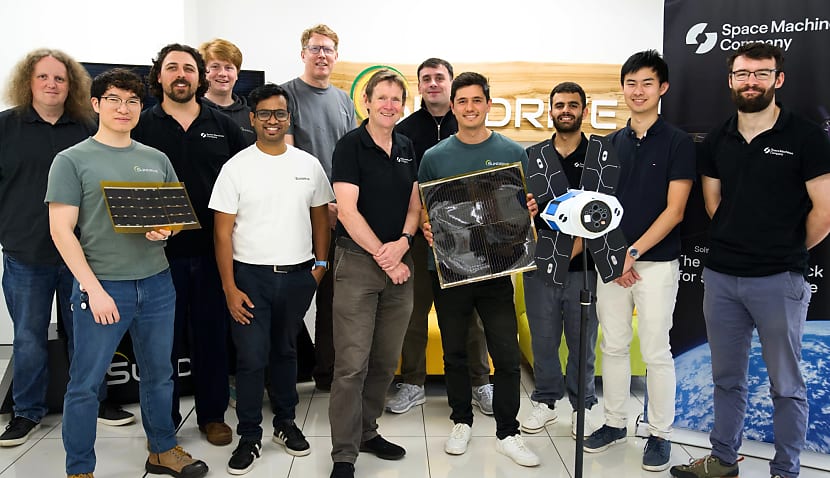
The partnership combines SunDrive’s copper-metallised solar cell technology with SMC’s expertise in spacecraft structures, thermal engineering and integration. The commercially driven partnership aims to establish an Australian-made source of solar arrays for spacecraft.
The first phase runs to April 2027. It will produce a body-mounted solar panel for SMC’s next-generation Optimus Viper spacecraft, plus prototype flight-sized panels.
The body-mounted panel will go through environmental testing, including thermal-vacuum and vibration testing. That testing will produce the engineering and performance data needed to move towards a flight-ready product.
Solar arrays are among the most critical and costly parts of any spacecraft. Australian satellite programs currently depend on imported space-grade arrays, which limits both cost and supply. Both companies see a market for lower-cost, locally developed solar arrays priced for spacecraft built and deployed at scale. Such arrays could power future Australian spacecraft, reduce reliance on overseas suppliers and strengthen Australia’s sovereign space manufacturing base.
“This collaboration began because two Australian companies saw a commercial reason to work together. Other nations are moving quickly to secure their space supply chains, and partnerships like this are how Australia builds capability that lasts,” according to Space Machines Company chief executive officer and co-founder Rajat Kulshrestha.
SunDrive was founded to take Australian solar innovation to the world. The Sydney-based company’s proprietary direct-copper plating technology replaces silver with abundant copper, enabling high-efficiency, scalable solar cells with lower reliance on critical materials.
Its copper heterojunction cells, which have delivered record-breaking results on Earth, are ultra-thin and lightweight. Those qualities matter in orbit, where every gram of array mass is a trade against payload. Optimus Viper gives the technology its first spacecraft application, designed for the conditions of Low Earth Orbit.
“SunDrive’s copper HJT technology brings together the ultra-thin, lightweight and high-efficiency performance needed for next-generation spacecraft solar arrays,” according to SunDrive Solar co-founder and chief technology officer Vince Allen.
“And applying that to SMC’s Optimus Viper program is a great opportunity to demonstrate what Australian innovation can achieve in the demanding environment of Low Earth Orbit.”
Space is one of the toughest environments for photovoltaic technology; the panels must survive launch. Testing to spacecraft standards is a key step towards flight heritage, which satellite manufacturers use as a benchmark when choosing components.
SunDrive will lead cell selection, module design, lamination and electrical characterisation. SMC will lead substrate design, structural and thermal analysis of the panel, assembly and testing, and mounting the panel on a structural model of Optimus Viper.
The two companies will jointly develop the process for bonding solar modules to the panel substrate. This work will provide the critical design and test data to develop the path towards a flight-ready, Australian-made solar array for commercial spacecraft.
“A solar panel has to survive launch vibration, vacuum and extreme thermal cycling while staying as light as possible. Those are exactly the problems our structures, thermal and test teams work on every day,” according to Space Machines Company Vice President of Engineering Ian Partis.
For SunDrive, the collaboration marks an important milestone in bringing its proven technology to the space sector, one of the most demanding energy applications there is. As the global space economy accelerates, demand is growing for power systems that are high-performance, resilient, lightweight and scalable.
Both companies want more of that value chain to stay in Australia. They aim to combine the country’s research base and engineering talent with industrial capability to design, validate and ultimately manufacture space-energy technology locally, building a domestic ecosystem and skilled jobs along the way.
“As the global space economy rapidly accelerates, Australia is well-placed to seize the opportunity, not just to participate, but to build and own the critical technologies that will underpin it,” according to SunDrive Solar chief executive officer Natalie Malligan.
Both companies intend to use the Phase 1 results to decide on further phases. Those phases would aim at a flight-ready deployable solar array for SMC’s future spacecraft and for the wider satellite market.
Engineering teams from both companies met at SunDrive’s Kurnell facility on 1 October 2026 to formally start the project.
 Want to see more stories from trusted news sources?
Make Space Connect a preferred news source on Google.
