


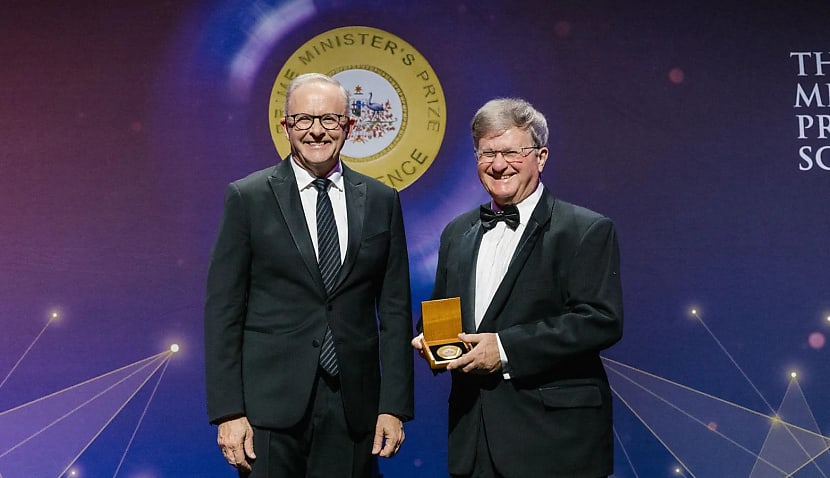
Professor Thomas, who holds the Elder Chair of Physics at Adelaide University, accepted the award from Prime Minister Anthony Albanese at a ceremony held in Parliament House, Canberra earlier this week.
He shared the honours with world renowned oncologist Professor Georgina Long AO. It is the first time in the history of the award that people from two different research areas have been jointly awarded Australia’s most prestigious Science Prize.
In a career spanning more than four decades, Professor Thomas has devoted his research to answering some of humanity’s most fundamental questions: What is matter made of? How do the particles inside atoms behave, and what forces shaped the Universe in the moments after the Big Bang?
His pioneering research focuses on quarks and gluons, the fundamental particles that form protons and neutrons, the building blocks of all visible matter.
Through theoretical physics, advanced mathematical modelling and powerful computer simulations, he has helped explain how these particles interact to create the matter that makes up everything from people and planets to stars and galaxies.
In addition to his groundbreaking work on the structure of protons, neutrons, atomic nuclei and neutron stars, Professor Thomas has also made important contributions to research into dark matter, one of the greatest unsolved mysteries in modern science.
“While our work investigates phenomena that are far too small to see, the questions we are asking are among the biggest in science,” said Professor Thomas.
“Understanding the fundamental laws of nature helps us understand how the Universe works. It expands human knowledge and lays foundations that future generations may use in ways we cannot yet imagine.”
A globally recognised leader in subatomic physics, Professor Thomas has accumulated more than 40,000 research citations and collaborates extensively with researchers and institutions around the world.
His work has influenced generations of physicists and helped establish Australia as a significant contributor to international research in nuclear and particle physics.
Among his many achievements, he co-founded the ARC Special Research Centre for the Subatomic Structure of Matter (CSSM), which for nearly three decades has been a major force in international research into the fundamental structure of matter.
Under his leadership, the Centre has created a world-class research environment, attracted leading scientists from around the globe, trained more than 120 postgraduate students, and played a key role in advancing theoretical and computational physics in Australia.
The Centre’s researchers have tackled some of the most profound questions in science, including how quarks and gluons combine to form matter, how matter behaves under extreme conditions, and whether there are still undiscovered forces or particles in nature.
Adelaide University Vice-Chancellor & President, Professor Nicola Phillips, said the award recognised not only Professor Thomas’s outstanding scientific achievements but also his lasting contribution to Australian research and education.
“Professor Thomas is one of Australia’s most distinguished physicists and a researcher whose work has reshaped our understanding of the subatomic world,” Professor Phillips said.
“His discoveries have had a profound impact on international physics, while his leadership has helped build Adelaide’s reputation as a global centre of excellence in fundamental science.”
South Australian Premier Peter Malinauskas congratulated Professor Thomas on this worthy recognition.
“Professor Thomas is a global leader in this field, and this award recognises the decades he has dedicated to helping us understand the world around us,” Premier Malinauskas said.
“It’s important that scientists like Professor Thomas are highlighted in society so they can help inspire future generations to pursue careers in STEM.”
Over his career, Professor Thomas has received numerous prestigious honours, including the Thomas Ranken Lyle Medal, Harrie Massey Medal, Walter Boas Medal, a Centenary Medal, and recognition as South Australian Scientist of the Year.
He was appointed a Companion of the Order of Australia (AC) in 2020 for his service to scientific education and research and was elected an Honorary Fellow of the Australian Institute of Physics in 2025.
The Prime Minister’s Prizes for Science include awards made in five categories — Science, Innovation, Physical Scientist of the Year, Life Scientist of the Year, and New Innovators. Prizemoney ranges from $50,000 to $250,000.
“Australian science matters and Australian scientists matter. Each of this year’s winners prove that,” according to Prime Minister Anthony Albanese.
“Helping pave a path to a brighter, smarter Australia.”
 Want to see more stories from trusted news sources?
Make Space Connect a preferred news source on Google.