


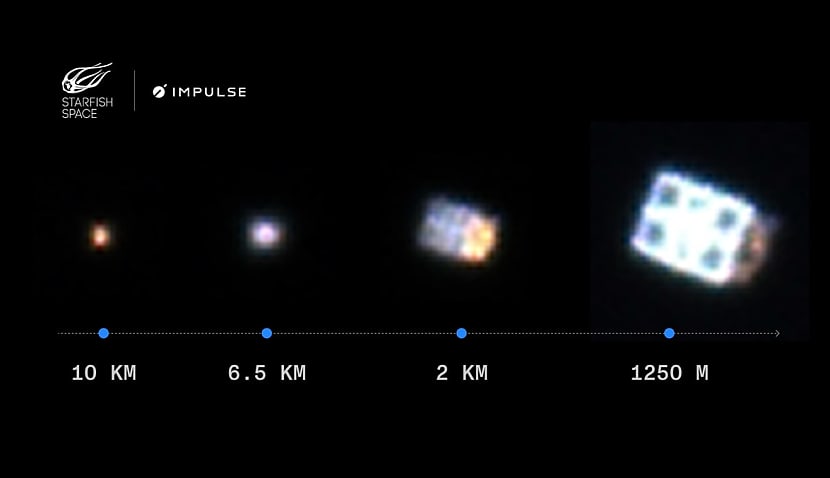
The mission was carried out using Impulse’s Mira spacecraft, with Starfish’s payloads allowing the spacecraft to fly close to another Impulse Mira already in orbit from an earlier mission. While operating in low-Earth orbit, Starfish’s software automatically controlled the spacecraft, guiding it through several manoeuvres.
“Mira is our agile, responsive spacecraft. Its manoeuvrability and high thrust make it perfectly suited for this type of mission,” said Eric Romo, Impulse Space president and COO.
“Together with our partners at Starfish, we brought this mission from concept to execution in less than a year. Our team is ready and able to execute quickly and deliver versatile, complex operations where success is paramount.
“We’re looking forward to more RPO missions across more orbits in the future.”
Unlike typical RPO missions, Remora used a single range camera as the only sensor, proving success for Starfish’s guidance, navigation, and control (GNC) software suites, CETACEAN and CEPHALOPOD.
These systems are set to be used in Starfish’s Otter satellite service mission, launching for SES, the US Space Force, and NASA, to name a few.
“With Remora, we set out to validate our unique approach to autonomous rendezvous and proximity operations in orbit,” said Dr Trevor Bennett, co-founder of Starfish Space.
“Proving this capability is a major milestone for Starfish, and gives us tremendous confidence as we move toward our first Otter launches next year.”
During the mission, images from an onboard camera were processed by Starfish’s CETACEAN software to estimate relative position and command Mira’s thrusters, enabling autonomous guidance.
The Remora mission was developed and launched within less than 12 months, launching aboard SpaceX’s Transporter-12 rideshare.
 Want to see more stories from trusted news sources?
Make Space Connect a preferred news source on Google.