


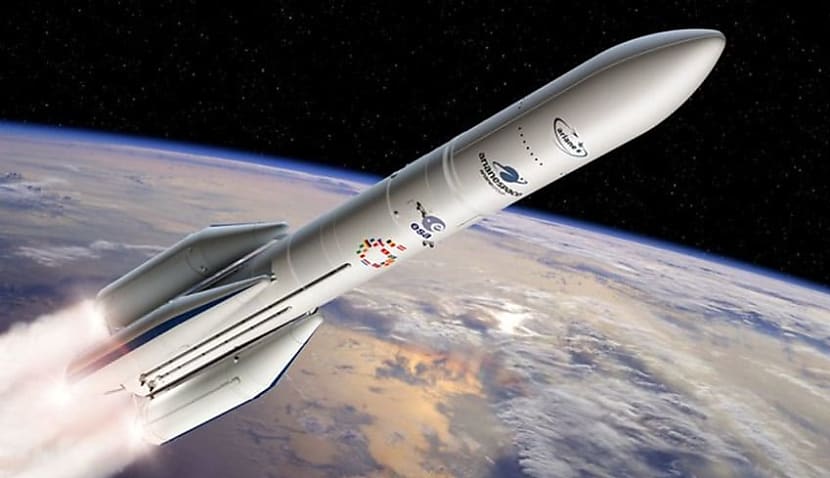
The launch, conducted on 12 February and operated by Arianespace, saw the four-booster Ariane 6 configuration carry 32 satellites for Amazon’s low-Earth orbit broadband constellation. Lift-off took place at 16:45 GMT from Europe’s spaceport in French Guiana, with the final satellites deployed 114 minutes later.
The mission marks the first operational flight of the Ariane 64 variant, the rocket’s most powerful configuration, and represents a significant step in ensuring Europe can independently launch critical civil, commercial and security payloads.
The Ariane 64 uses four P120C solid rocket boosters, doubling the payload capacity of the two-booster Ariane 62 variant. The additional thrust allows the vehicle to deliver up to 21.6 tonnes into low-Earth orbit, more than twice the 10.3 tonnes achievable with the smaller configuration.
European Space Agency (ESA) director general Josef Aschbacher said the successful launch marked a turning point, saying, “With the powerful roar of four boosters at lift-off comes more than double the payload mass to orbit.”
“This sets Europe back on stage for launching all satellites to all orbits. Our rocket fleet is now complete and further upgrades are already underway,” Aschbacher added.
Standing 62 metres tall with a 20-metre payload fairing, the rocket is roughly equivalent in height to a 20-storey building and is the tallest Ariane 6 assembled to date.
The successful ignition and coordinated performance of all four boosters demonstrated the rocket’s full operational capability, placing it in a higher class of global launch vehicles capable of supporting large satellite deployments and complex missions.
The upper stage’s auxiliary propulsion system enabled the rapid deployment of the 32 satellites in under two hours, highlighting the rocket’s suitability for large-scale constellation launches.
Following satellite deployment, the upper stage conducted a controlled third burn to ensure safe atmospheric re-entry, consistent with Europe’s “zero debris” approach to responsible space operations.
ESA director of space transportation Toni Tolker‑Nielsen said the mission demonstrated Europe’s restored launch autonomy: “This first flight of Ariane 64 sustains Europe’s autonomous access to space.”
“We can now transport small to large payloads to a wide range of orbits using Europe’s complete rocket fleet.”
The Ariane 6 program represents a major collaborative effort across Europe’s space sector. Development has involved an industrial network spanning 13 countries, led by prime contractor ArianeGroup, with launch operations managed by France’s national space agency, CNES.
The rocket’s successful debut in its most powerful configuration restores Europe’s ability to independently launch heavy payloads following the retirement of the Ariane 5 and delays to Ariane 6’s introduction.
The Ariane 64 configuration will play a critical role in supporting Europe’s scientific, defence and commercial space ambitions, including future missions such as ESA’s Plato exoplanet-hunting spacecraft.
The successful launch also strengthens Europe’s position in the increasingly competitive global launch market, where reliable heavy-lift capability is essential for deploying satellite constellations, national security assets and scientific missions.
With Ariane 62 and Ariane 64 now operational, European space authorities said the continent has regained full independent launch capability across the full spectrum of mission requirements.
 Want to see more stories from trusted news sources?
Make Space Connect a preferred news source on Google.