


The mission, formally known as Solar wind Magnetosphere Ionosphere Link Explorer (SMILE), lifted off at 4:52am BST and marks a major international scientific effort to better understand the interaction between the sun and Earth, particularly the impacts of space weather.
Developed as a collaboration led by the European Space Agency, the mission will use four scientific instruments to investigate how Earth’s magnetic environment responds to solar wind – the constant stream of charged particles emitted by the sun. Scientists hope the mission will improve understanding of solar storms, geomagnetic disturbances and the broader dynamics of space weather, which can affect satellites, communications systems, power grids and astronauts in orbit.
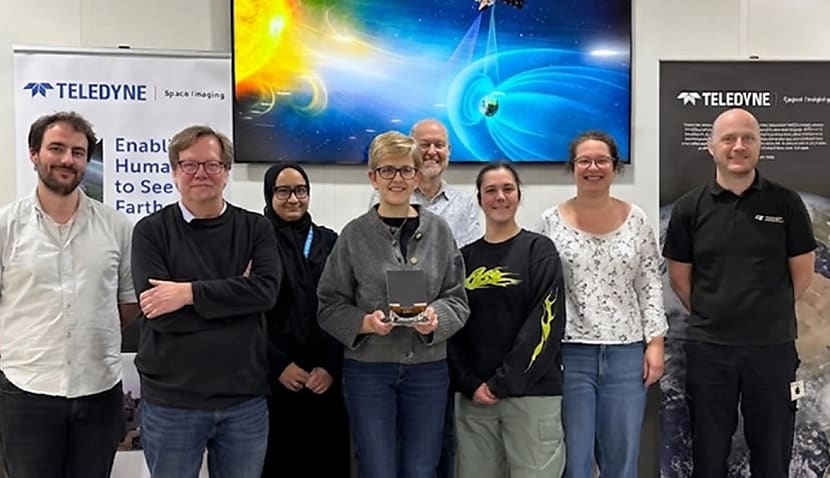
At the centre of the spacecraft’s soft X-ray imager are two CCD370 imaging sensors designed and manufactured by Teledyne Space Imaging in Chelmsford, England. The sensors are engineered to capture soft X-ray emissions produced when solar wind particles interact with Earth’s magnetic field.
The highly specialised detectors will observe photons across an energy range of 0.2 to 2.0 keV, allowing researchers to study the boundary regions where the solar wind collides with Earth’s magnetosphere. The mission is expected to deliver unprecedented insights into the processes shaping the near-Earth space environment.
David Morris, Teledyne chief engineer, said the mission would provide scientists with a completely new perspective on the relationship between the sun and Earth.
“Our CCD technology is enabling this mission to become the first to image Earth’s magnetosphere using X-ray light, helping scientists better understand the mechanisms behind space weather,” Morris said.
Teledyne general manager Daniel Waller said the company is proud to support a mission with significant scientific and practical implications.
“Understanding space weather helps protect our planet, the technology we rely on, and astronauts operating in space,” Waller said.
All design, manufacturing, testing and qualification work for the CCD detectors was completed at Teledyne Space Imaging’s facility in Chelmsford, continuing the company’s long-running involvement in major international space missions.
 Want to see more stories from trusted news sources?
Make Space Connect a preferred news source on Google.