


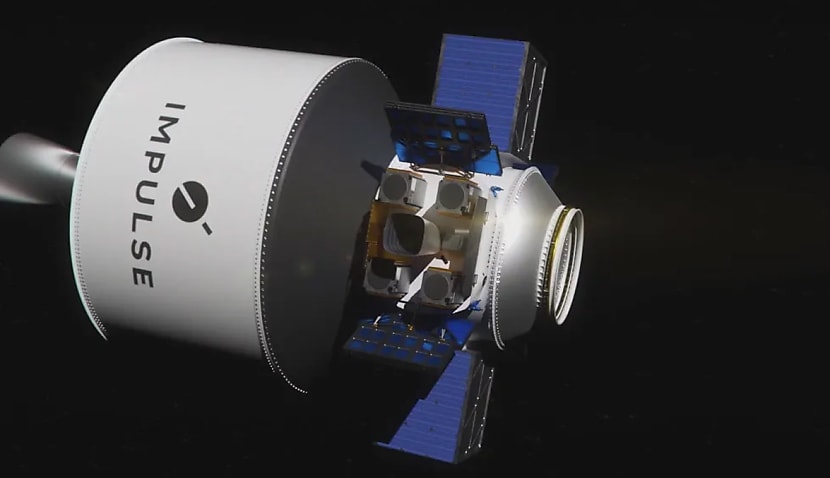
The Series D funding round – co-led by investment firms 137 Ventures and BANNER VC – takes the company’s total capital raised to more than US$1 billion and underscores growing confidence in what many investors see as a critical emerging segment of the space economy: in-space mobility.
Founded by former SpaceX propulsion chief Tom Mueller, Impulse Space is focused on solving one of the industry’s longstanding challenges. While launch services have become cheaper and more accessible over the past decade, spacecraft often remain constrained once they reach orbit, limiting their ability to relocate, change missions, or access more distant destinations.
Impulse aims to address that challenge by developing spacecraft and propulsion systems capable of rapidly transporting payloads between orbits, conducting complex manoeuvres, and supporting future operations beyond Earth orbit.
“We’re building more than spacecraft – we’re building the economic and technical engine that will power humanity’s expansion into space,” Mueller said.
“From Earth orbit to the Moon and beyond, the ability to move quickly, precisely and affordably in space will be a fundamental capability for the next generation of missions.”
The company has already completed three missions and secured hundreds of millions of dollars in customer contracts across commercial, civil, and government sectors.
Its growing portfolio includes Mira – a spacecraft designed for precision manoeuvring and orbital repositioning – which has already completed multiple missions involving complex rendezvous and proximity operations.
Impulse is also developing Helios, a high-energy transfer vehicle scheduled to make its maiden flight in 2027. The spacecraft is intended to transport payloads to distant orbits significantly faster and at lower cost than conventional approaches.
Another initiative, known as Caravan, aims to provide rideshare access to higher-energy destinations, such as geostationary orbit, reducing costs for satellite operators.
Supporting those platforms is a family of propulsion systems tailored to different mission requirements, ranging from precision orbital adjustments to long-distance transport and future lunar landing operations.
The latest funding will be used to expand manufacturing capacity and grow the company’s workforce, which has more than doubled over the past year. Impulse currently has more than 200 open positions across engineering, manufacturing, and mission operations as it scales operations to meet rapidly growing demand.
Company president and chief operating officer Eric Romo said the investment would allow Impulse to increase production while maintaining the speed and quality that have underpinned its growth.
“Demand for in-space mobility is exceptionally strong, and this funding positions us to meet that demand at scale,” Romo said.
 Want to see more stories from trusted news sources?
Make Space Connect a preferred news source on Google.