


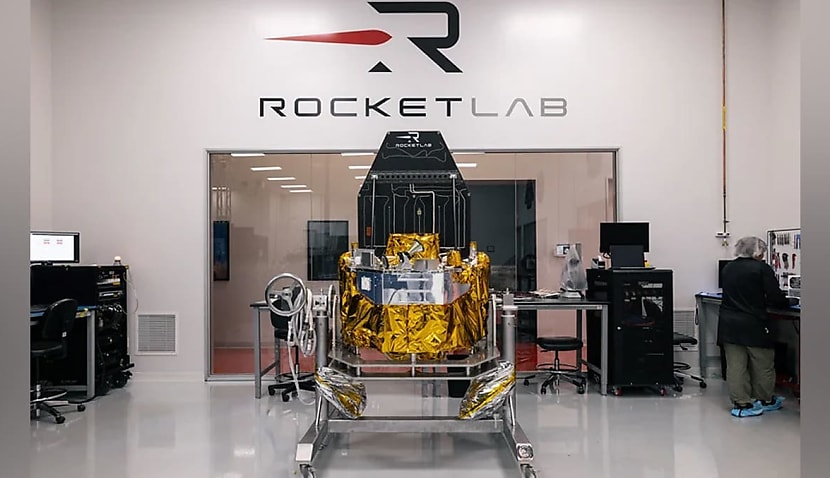
The company’s successful execution of the Victus Haze mission establishes a new benchmark for tactically responsive space operations, demonstrating the ability to rapidly launch, commission and manoeuvre a satellite to locate and inspect another spacecraft with minimal notice.
Unlike traditional missions that rely on multiple contractors to provide launch vehicles, satellites and mission operations, Rocket Lab delivered the entire capability as the program’s prime contractor, integrating spacecraft design, launch services and on-orbit operations into a single end-to-end solution.
The mission centred on Rocket Lab’s Pioneer spacecraft, which was designed, built and tested specifically for the United States Space Force (USSF) before being launched aboard the company’s Electron rocket following exceptionally short notice.
After receiving formal authorisation to launch from the Space Force, Rocket Lab successfully lifted off just 16 hours and 42 minutes later, the fastest response time ever achieved under the US military’s Tactically Responsive Space program.
Following launch, Rocket Lab’s mission operations team completed commissioning of the Pioneer spacecraft in just 38 hours, comfortably beating the USSF’s 72-hour requirement by more than 30 hours.
During commissioning, engineers activated and verified all critical spacecraft systems, including power, communications and attitude control, ensuring the satellite was fully operational before beginning its space domain awareness mission.
The final and most technically demanding phase involved complex rendezvous and proximity operations, with Pioneer successfully locating, tracking, approaching and imaging a target satellite in orbit.
Those operations were completed in under 59 hours – around 25 hours ahead of the Space Force’s required timeline while maintaining continuous tracking and precision orbital manoeuvring throughout the mission.
The successful demonstration validates Rocket Lab’s growing capability to rapidly deploy satellites capable of conducting space surveillance, inspection and tracking missions in response to emerging threats, an increasingly important requirement as military competition expands into the space domain.
Rocket Lab founder and chief executive Sir Peter Beck said the mission represented a significant milestone for both the company and the broader responsive space sector.
“Rocket Lab has established a new benchmark for responsive space through Victus Haze,” Beck said.
“Delivering a fully integrated mission capability under significant time pressure is a tremendous achievement for our team and builds on our long history of supporting the United States and its allies.
“With the primary mission now complete, we look forward to continuing to operate Pioneer under increasingly complex Space Force taskings and demonstrating even more advanced capabilities.”
Victus Haze was delivered by the US Space Force’s Space Systems Command through its Space Safari Program Office in partnership with the Defense Innovation Unit. The initiative is designed to develop technologies, operational concepts and experience that will enable rapid, repeatable responses to emerging threats in space.
Although the primary demonstration has now concluded, Rocket Lab will continue operating the Pioneer spacecraft for several more months, undertaking additional rendezvous and proximity missions as directed by Space Safari to further refine advanced operational techniques.
The mission further strengthens Rocket Lab’s position as one of the world’s leading providers of responsive launch and national security space capabilities, highlighting the company’s ability to rapidly deliver integrated space missions combining launch vehicles, spacecraft and mission operations under compressed timelines.
 Want to see more stories from trusted news sources?
Make Space Connect a preferred news source on Google.