


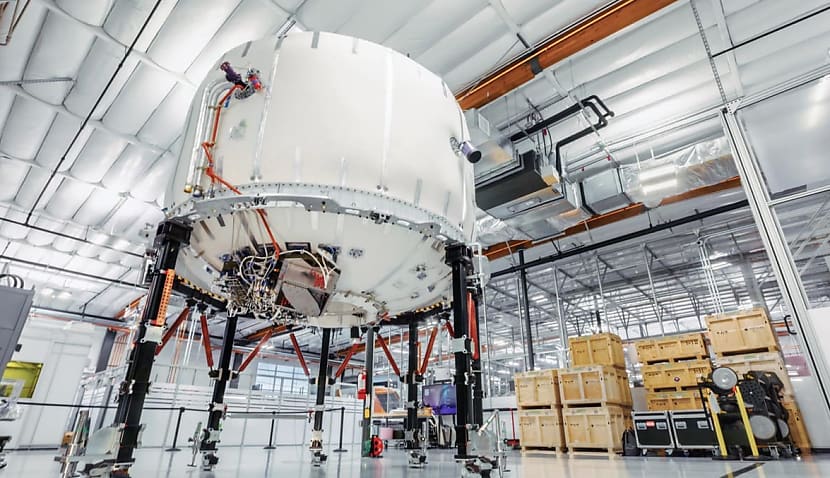
The contract marks a significant milestone for the California-based space mobility company and opens the door for Helios, its next-generation orbital transfer vehicle, to compete for future national security launch missions.
Awarded by the US Space Force’s Space Systems Command, the Firm Fixed-Price, Indefinite-Delivery Indefinite-Quantity contract enables Impulse Space to complete the assessments and mission assurance activities required to join the pool of providers eligible to bid for future National Security Space Launch (NSSL) Phase 3 Lane 1 task orders.
The Lane 1 program is designed to leverage commercial launch capabilities for national security missions that can accept a higher degree of operational risk, expanding the number of providers available to deliver responsive and cost-effective access to space.
Rather than supplying an entire launch vehicle, Impulse Space will provide its Helios high-energy upper stage, which will operate in partnership with an established medium-lift launch provider.
Helios is designed to transport payloads from low-Earth orbit to higher-energy destinations, including medium Earth orbit, geosynchronous orbit, lunar trajectories and other deep-space missions – in less than 24 hours, significantly reducing transfer times compared with many conventional orbital delivery approaches.
The award represents a notable shift in how national security launch services are being procured. Historically, prime contractors within the NSSL program have been launch vehicle manufacturers responsible for the entire mission. Impulse Space is the first company specialising in orbital transfer vehicles to be recognised as the lead contractor for this type of capability.
As part of the agreement, the company will receive an initial US$5 million task order to support the first phase of the on-ramping process, including capability assessments and the development of mission assurance requirements ahead of competing for operational launch contracts.
Impulse Space president and chief operating officer Eric Romo said the contract recognised the growing importance of in-space mobility within modern national security architectures.
“Being selected for the NSSL Phase 3 program is a significant endorsement of the capabilities we’re developing at Impulse Space,” Romo said.
“Combining Helios with commercially available medium-lift launch vehicles provides the Space Force with a more flexible and cost-effective pathway to high-energy orbits while expanding assured access to space.”
Helios is currently progressing through its development program ahead of its inaugural flight, which is scheduled for 2027.
The spacecraft will be powered by Impulse Space’s Deneb engine and is intended to provide rapid orbital transfer services for government and commercial customers, supporting missions ranging from geostationary satellite deployment through to lunar exploration and deep-space operations.
The contract also reflects the US Space Force’s broader strategy of expanding its industrial base by incorporating emerging commercial capabilities into national security missions, reducing reliance on a small number of traditional launch providers while increasing operational resilience and responsiveness.
 Want to see more stories from trusted news sources?
Make Space Connect a preferred news source on Google.