


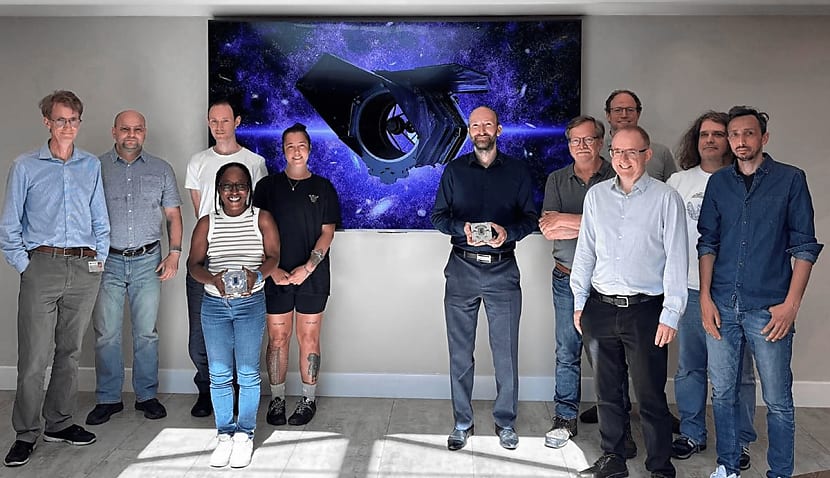
With the launch of the Roman Space Telescope, there are now more than 1,000 Teledyne scientific imaging sensors in space, including those aboard the Hubble and James Webb missions.
The detector technologies supplied by Teledyne support both of Roman Space Telescope’s primary scientific instruments, enabling investigations into dark energy exoplanets, and a broad range of astrophysical phenomena.
This latest achievement reinforces the company’s position as a leading supplier of advanced detector technologies for scientific, commercial and governmental space missions.
In 2018, Teledyne was awarded a US$23 million contract by NASA to provide 24 flight-quality sensor chip assemblies for the Roman Space Telescope mission, later expanded to 28.
Each delivered detector surpassed performance specifications for quantum efficiency, low noise and image persistence, while also enabling a 20 per cent increase in the instrument’s spectral bandwidth.
For the mission’s Wide Field Instrument, Teledyne supplied the H4RG-10 infrared detector arrays that form the Roman Space Telescope’s distinctive focal plane, the largest infrared focal plane ever flown in space. Each detector contains more than 16 million pixels arranged in a 4096 × 4096 format. Together, 18 H4RG-10 detectors create a mosaic of more than 300 million pixels, with a unique shape that inspired the iconic Roman mission logo selected by NASA.
Teledyne also supplied three CCD311-20 detectors for the Roman Space Telescope’s coronagraph Instrument, one of the most advanced high-contrast imaging systems ever flown in space. The coronagraph Instrument combines precision coronagraph masks, deformable mirrors, wavefront sensing and control systems, and electron-multiplying CCD technology to suppress starlight and directly observe much fainter planetary systems. The technology demonstration is expected to help pave the way for future missions capable of directly imaging Earth-like planets around nearby stars.
“Reaching more than 1,000 scientific, space-qualified imaging sensors in orbit is a proud achievement for everyone at Teledyne,” said Teledyne Space Imaging president Megan Tremer.
“It reflects our longstanding commitment to advancing imaging technology and supporting the world’s most ambitious space missions.
“Roman is another important chapter in that story, and we are excited to see how it expands our understanding of the universe.”
The Roman Space Telescope is NASA’s latest flagship astrophysics observatory, designed to survey billions of galaxies and observe distant stellar explosions to help scientists investigate dark energy, the mysterious force driving the accelerating expansion of the universe.
The mission will also identify thousands of exoplanets beyond our solar system, including planetary systems that have never previously been studied on such a scale. It combines a field of view around 200 times larger than the Hubble Space Telescope’s infrared observations.
Beyond these primary objectives, the Roman Space Telescope will support a broad range of astronomical research, from studying star formation in neighbouring galaxies and supermassive black holes in the distant universe to investigating the environments where stars and planetary systems are born. The observatory will also contribute to our understanding of objects within our own solar system.
The Roman Space Telescope builds on more than four decades of Teledyne innovation in detector technology. Today, Teledyne’s imaging sensors support many of the world’s leading scientific and Earth observation missions, including the Hubble Space Telescope, James Webb Space Telescope, Euclid Space Telescope, ESA’s Sentinel missions, and NOAA’s and NASA’s GOES program.
 Want to see more stories from trusted news sources?
Make Space Connect a preferred news source on Google.