


The contest for leadership in space is increasingly being decided not only by who can design the most advanced satellites or launch vehicles, but by who can manufacture them at scale.
That reality has been reinforced by US advanced manufacturing company Hadrian, which has announced a $260 million capital raise alongside a sweeping expansion of its AI-powered manufacturing network aimed at dramatically increasing production capacity for defence, aerospace and space industries.
The funding package, comprising a Series C investment led by existing backers Founders Fund and Lux Capital together with a factory expansion loan facility arranged by Morgan Stanley, will enable the company to expand beyond the precision component manufacturing that initially defined its business.
Instead, Hadrian is positioning itself as a full-spectrum advanced manufacturer capable of producing complete mission-critical systems, from raw materials through to finished assemblies and operational platforms.
For the rapidly expanding space sector, this represents a significant shift.
Rather than simply supplying individual components, companies developing satellites, launch vehicles, spacecraft and other orbital systems will increasingly be able to leverage highly automated manufacturing capable of rapidly producing entire subsystems and finished hardware.
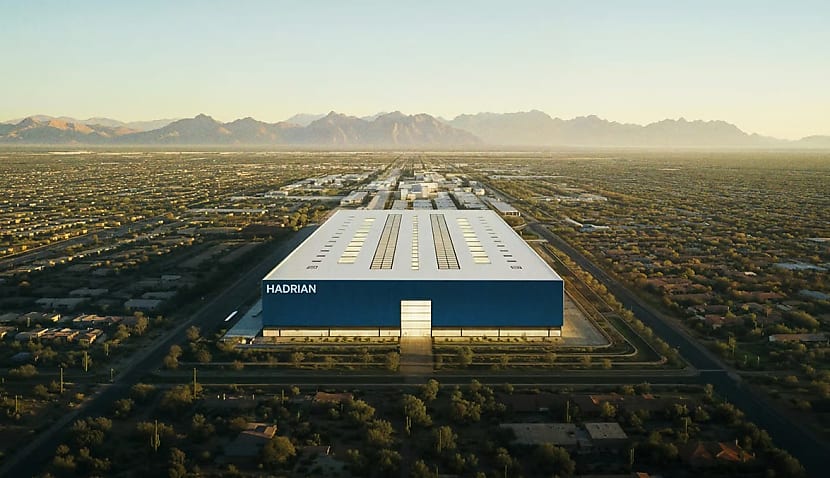
Central to the expansion is a new 270,000-square-foot manufacturing and software facility in Mesa, Arizona, representing around $200 million in investment and expected to create 350 highly skilled jobs. The company has also commenced the search for a new 400,000-square-foot corporate headquarters and research and development centre that will support the recruitment of thousands of additional employees.
The expansion reflects growing demand across both defence and commercial space industries for manufacturing systems capable of producing increasingly sophisticated hardware at much greater speed than traditional industrial models.
Powered by Hadrian’s proprietary autonomous manufacturing software platform, Opus, the company said new factories can be brought online in less than six months, allowing production capacity to expand rapidly as demand increases.
That capability is becoming increasingly important as governments seek to strengthen sovereign industrial resilience while simultaneously accelerating production of satellites, launch infrastructure, hypersonic technologies, missile systems and advanced aerospace platforms.
Alongside its physical expansion, Hadrian has also launched its new “factories-as-a-service” model, allowing major defence and aerospace companies to rapidly scale production capacity without investing in entirely new manufacturing infrastructure themselves.
The model is expected to support a broad range of high-priority defence programs while also providing significant opportunities for companies operating in the commercial and national security space sectors that require resilient, high-volume manufacturing capability.
Hadrian has also established a dedicated maritime division focused on autonomous shipbuilding production and confirmed additional business units covering munitions, missile systems and uncrewed aerial systems will be announced in the coming months.
Although naval production forms part of the company’s expansion, the broader significance lies in the emergence of AI-enabled factories capable of supporting every domain of modern defence, particularly space, where production bottlenecks have increasingly become a limiting factor in deploying constellations and rapidly replacing on-orbit assets.
According to founder and chief executive Chris Power, rebuilding America’s industrial capacity is essential to maintaining technological leadership in an era of intensifying strategic competition.
“China is making massive bets on industrial dominance,” Power said. “The United States needs to respond not just with policy, but with production.”
The company’s growth trajectory suggests that vision is already gaining momentum.
Since its previous funding round just 12 months ago, Hadrian said it has recorded tenfold year-on-year growth and now intends to establish a further four to five manufacturing facilities over the next year.
As governments increasingly recognise that industrial capacity has become as strategically important as technological innovation itself, Hadrian’s expansion highlights a broader transformation underway across the defence industrial base – one in which AI-enabled factories may become just as critical to maintaining space superiority as the spacecraft they ultimately produce.
 Want to see more stories from trusted news sources?
Make Space Connect a preferred news source on Google.