


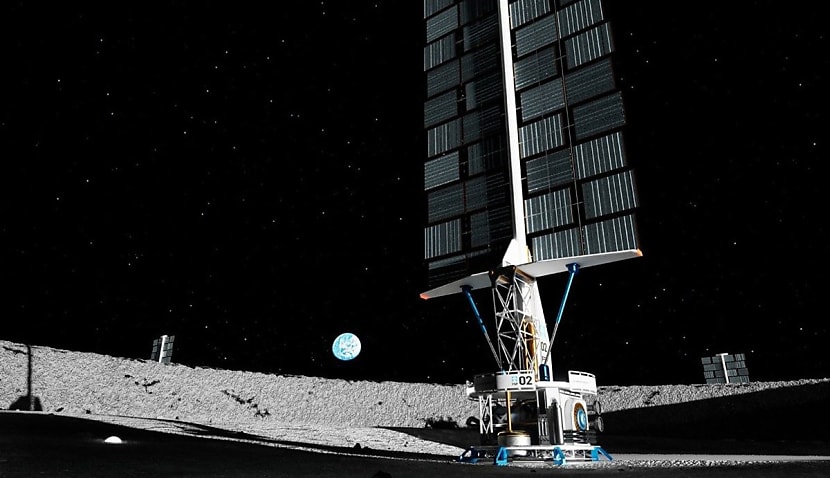
As space agencies ramp up preparations for the Artemis program, experts say one of the biggest technical challenges remains how to reliably power infrastructure during the moon’s harsh two-week-long nights.
Unlike Earth, the moon experiences roughly 14 days of continuous darkness during each lunar night, making solar power alone difficult to rely on. Many of the moon’s most valuable resources, including ice deposits believed to exist in permanently shadowed craters near the poles, are also located in areas that receive little or no sunlight.
This has led NASA and the White House to identify fission surface power reactors as the preferred energy source for a future lunar base.
A recent White House executive order called for the development and deployment of “nuclear reactors on the moon and in orbit”, including a surface reactor ready for launch by 2030.
According to aerospace giant Lockheed Martin, the technology could provide reliable power for habitats, robotic rovers and industrial facilities that process lunar materials.
“Prior to the executive order, it was a chicken-and-egg scenario – do we wait for the demand or is it, ‘You build it, and they will come?’” said Bill Pratt, director of in-space infrastructure at Lockheed Martin.
“This order addresses that, establishing a nuclear power source through the lunar night where industry and government build architectures and establish business cases and models for the future. NASA is developing an anchor for future commercialisation.”
The concept centres on compact nuclear reactors capable of producing between five and 50 kilowatts of electricity. A smaller reactor could power a single habitat or rover charging station, while larger units could support multiple research stations and emerging commercial operations.
Lockheed Martin has been developing the concept for several years, drawing on its experience with space systems and nuclear technologies used in naval submarines. In 2022 the company was awarded a contract by the United States Department of Energy and NASA to develop an early reactor design. An extension to the program in 2025 added a testbed aimed at reducing technical risks in space-based nuclear power systems.
Company officials said the technology could form the foundation of a modular power grid on the moon, capable of expanding as exploration and industry grow.
“Our overall architecture is flexible and accommodates a wide range of user loads,” said Kerry Timmons, business strategy lead for Lockheed Martin’s nuclear space programs.
“But making a 100-kilowatt reactor for moon and Mars operations is more than just scaling up a smaller design. It’s learning to master higher-temperature Brayton cycles and thermal management while ensuring the system can operate autonomously.”
Ultimately, supporters said nuclear reactors could power energy-intensive activities such as extracting oxygen and fuel from lunar soil, an important step towards building a permanent human presence beyond Earth.
“We need to build fast in this space race, but also sustainably if we are to grow the Artemis moon base and nurture future commercial markets,” Pratt said.
 Want to see more stories from trusted news sources?
Make Space Connect a preferred news source on Google.