


As part of the landmark flight, NASA will trial an advanced optical (laser) communications system aboard the Orion spacecraft, aiming to demonstrate how the technology can support future human spaceflight operations.
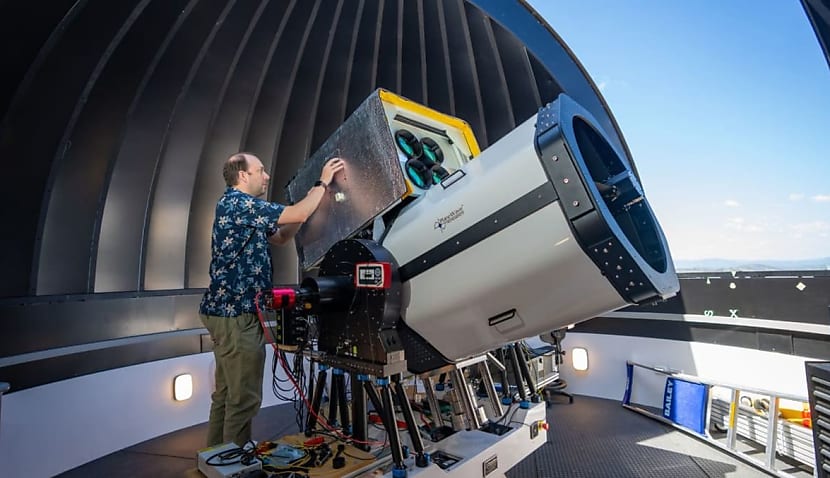
Researchers at ANU will contribute via the Quantum Optical Ground Station at Mount Stromlo Observatory, which will track, transmit and receive signals from Orion during the mission. The effort will test the capability of optical ground stations in the southern hemisphere and help pave the way for communications supporting future lunar missions.
Project lead Professor Francis Bennet said ANU had worked closely with NASA to rapidly build a sovereign capability in optical communications.
“We’ve established a cutting-edge system in the southern hemisphere to support NASA’s future communications needs,” he said. “This has been made possible through Australian government investment and strong collaboration with NASA on low-cost, adaptable technologies.”
Associate director of strategic projects at the ANU Institute for Space, Dr Kate Ferguson, said the capability was critical for reliable communications beyond Earth.
“Developing this infrastructure in the southern hemisphere is essential for consistent links to the moon and deeper into the solar system,” she said. “This mission represents years of research and confirms Australia’s readiness to support both exploration and commercial space activity.”
During the 10-day mission, ANU researchers will work alongside teams from NASA’s Glenn Research Center, Goddard Space Flight Center and Johnson Space Center.
Unlike traditional radio systems, laser communications use infrared light to transmit data, enabling speeds up to 100 times faster. The technology allows high-definition video, images, voice and scientific data to be sent across vast distances far more efficiently.
While NASA has previously tested laser communications, Artemis II will be the first time the technology is trialled on a crewed mission at such distance.
ANU’s ground station will complement NASA’s primary facilities in New Mexico and California, forming part of a broader global network. Through a partnership with the Australian Space Agency, data from Orion will also be transmitted to Australia during the mission.
Head of the Australian Space Agency, Enrico Palermo, said the collaboration highlights Australia’s growing reputation in advanced space technologies.
“Australian researchers are recognised globally for excellence in optical communications,” he said. “By combining this expertise with our geographic advantages, Australia is strengthening its role as a trusted international space partner.”
The Artemis II mission is scheduled to launch no earlier than 2 April (Canberra time). It forms part of NASA’s broader Artemis program, which aims to return humans to the moon, enable sustained exploration and lay the groundwork for future missions to Mars.
The Mount Stromlo facility has been supported by a $4.5 million investment from the Australian Space Agency under its Moon to Mars Demonstrator Mission program, alongside contributions from the ACT government, CSIRO and ANU.
 Want to see more stories from trusted news sources?
Make Space Connect a preferred news source on Google.