


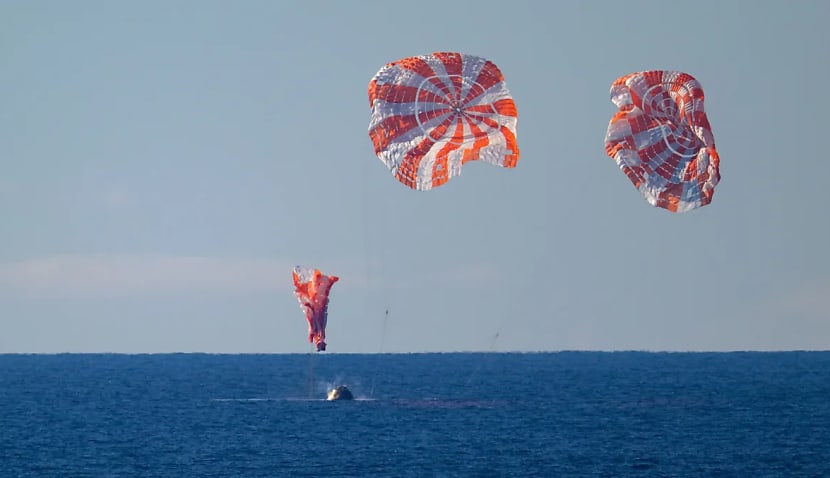
Cheers erupted in NASA mission control as confirmation came through that all systems had performed as expected during re-entry and recovery operations, supported by the US Navy.
As Orion re-entered, the spacecraft tore through Earth’s atmosphere at speeds exceeding 38,600km/h for a period, with temperatures expected to reach nearly 3,000 degrees during part of the descent, slowed with the aid of parachutes to approximately 32 kilometres per hour before landing in the ocean.
After a journey of more than a week, the Orion spacecraft splashed down safely off the coast of California, carrying its four-person crew – Commander Reid Wiseman, pilot Victor Glover, mission specialist Christina Koch and Jeremy Hansen – back from a historic lunar fly-by, the first time astronauts have travelled beyond low-Earth orbit since the Apollo era.
Hansen, speaking during the mission in remarks released by the Canadian Space Agency, reflected on the perspective gained from deep space: “Witnessing Earth beyond the edge of the moon is a powerful reminder that we all share this one planet.”
NASA said the mission’s success clears the way for Artemis III, which is intended to land astronauts on the lunar surface later this decade, including the first woman and the next man to walk on the moon.
This was reinforced by the Trump administration's new NASA administrator, Jared Isaacman, who said from the deck of a Navy ship engaged in the pick-up: “We are back in the business of sending astronauts to the moon, bringing them back safely and [are] set up for a series more.”
Isaacman later added: “Artemis II demonstrated extraordinary skill, courage and dedication as the crew pushed Orion, SLS (Space Launch System) and human exploration farther than ever before. As the first astronauts to fly this rocket and spacecraft, the crew accepted significant risk in service of the knowledge gained and the future we are determined to build.
“NASA also acknowledges the contributions of the entire NASA workforce, along with our international partners, whose expertise and commitment were essential to this mission’s success. With Artemis II complete, focus now turns confidently toward assembling Artemis III and preparing to return to the lunar surface, build the base, and never give up the moon again.”
The impact of Artemis II and the next steps for NASA were expanded upon by NASA associate administrator Amit Kshatriya, who added: “Artemis II proved the vehicle, the teams, the architecture and the international partnership that will return humanity to the lunar surface. Reid, Victor, Christina, and Jeremy carried the hopes of this world farther than humans have travelled in more than half a century. Fifty‑three years ago, humanity left the moon. This time, we returned to stay. The future is ours to win.”
Backed by NASA, the mission also pushed ahead with human health research, including the AVATAR experiment, which is probing how tissue responds to microgravity and deep space radiation, key to unlocking long-duration missions to the moon and Mars.
During a 6 April lunar fly-by, the crew captured more than 7,000 images, including a dramatic solar eclipse from Orion’s vantage point, as well as detailed shots of craters, lava plains and the lunar terminator, terrain and lighting conditions mirroring those expected at planned south pole landing sites.
They also recorded meteoroid impacts on the moon’s night side and flagged potential new crater names, adding to growing lunar intelligence.
The result: sharper mission planning, better trained crews, and a clearer path towards boots on the moon later this decade.
The Artemis program is also designed to establish a sustained human presence in lunar orbit and on the surface, as a precursor to future missions to Mars.
The successful return of Artemis II is being seen as a critical proof point for both the Orion spacecraft and NASA’s broader deep space exploration ambitions, demonstrating that the agency can once again send humans safely into deep space and bring them home.
 Want to see more stories from trusted news sources?
Make Space Connect a preferred news source on Google.