


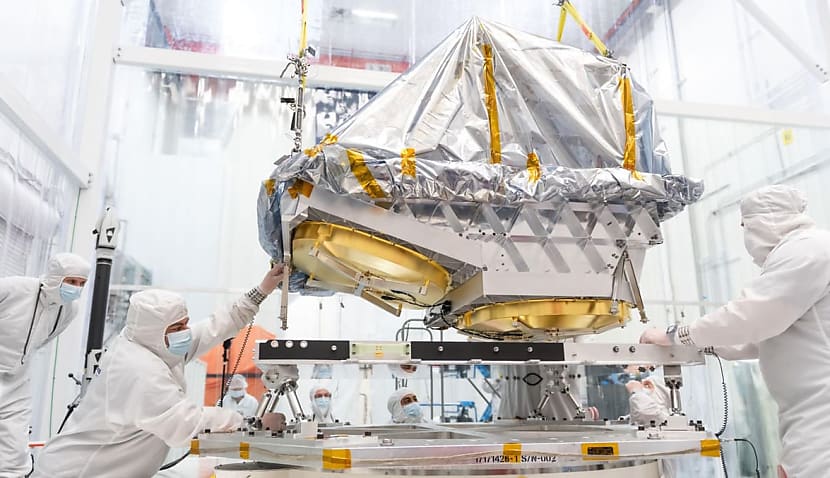
Scheduled to launch no earlier than September 2027, the mission will become NASA’s first infrared space telescope specifically designed to detect potentially hazardous asteroids and comets that could pose a future threat to Earth.
The spacecraft is being developed in response to a 2005 directive from the US Congress tasking NASA with identifying dangerous near-Earth objects, commonly known as NEOs. While ground-based telescopes have discovered thousands of asteroids over recent decades, many remain difficult to detect because they are either extremely dark, relatively small, or hidden in the sun’s glare.
Unlike conventional optical observatories, which rely on reflected sunlight, NEO Surveyor will use infrared sensors to detect the heat signatures emitted by asteroids and comets as they warm under the sun’s radiation. The approach is expected to significantly improve NASA’s ability to identify hard-to-find objects with enough warning time for potential mitigation efforts if required.
Once launched, the spacecraft will travel around 1.5 million kilometres from Earth towards the sun to the sun-Earth L1 Lagrange point, a region of gravitational stability that will allow the observatory to continuously scan large sections of the sky over a planned five-year mission.
NASA Jet Propulsion Laboratory project manager Jim Fanson described the mission as a critical step in strengthening planetary defence capabilities.
“NEO Surveyor is a one-of-a-kind mission designed to solve a specific challenge: finding asteroids and comets that pose the greatest risk to Earth,” Fanson said.
“By identifying objects that ground telescopes can miss, this mission will provide the critical data we need to help safeguard the planet for years to come.”
Major components of the spacecraft are now undergoing integration and testing at facilities across the US. The telescope and its specialised instrument enclosure are currently being tested at Space Dynamics Laboratory, part of Utah State University.
The enclosure, measuring approximately 3.7 metres in length, is designed to shield the sensitive infrared telescope from heat that could interfere with observations. Engineers will conduct thermal vacuum testing to simulate the harsh conditions of deep space and verify the system can maintain focus in extreme cold and zero gravity.
At the heart of the observatory is a dual-array infrared camera system capable of producing detailed 16-megapixel sky mosaics across two separate infrared wavelengths. By analysing the temperature of detected objects, scientists will be able to estimate asteroid and comet sizes more accurately than with optical systems alone.
One of the spacecraft’s most distinctive features will be its six-metre-long sunshade, designed to block direct sunlight and allow the telescope to safely observe objects closer to the sun than traditional telescopes can manage. The sun-facing side of the structure will also incorporate solar panels to power the spacecraft.
The sunshade and spacecraft bus, which houses propulsion, communications, avionics, and power systems, are currently being tested by BAE Systems in Boulder, Colorado.
Meanwhile, scientists are refining the mission’s survey strategy to maximise the observatory’s effectiveness once operational.
Mission lead Amy Mainzer from University of California, Los Angeles, said researchers were working to optimise the spacecraft’s ability to detect some of the solar system’s most elusive objects.
“We are developing the most efficient survey strategy possible to detect some of the hardest-to-find asteroids in the solar system, as well as any comets that may be headed our way,” Mainzer said.
Data collected by the spacecraft will be transmitted back to Earth through NASA’s Deep Space Network before being processed at the NEO Surveyor Survey Data Center operated by California Institute of Technology. Observations will then be provided to the international Minor Planet Center, which is responsible for cataloguing newly discovered objects.
The information will also support planetary defence efforts led by NASA’s Center for Near Earth Object Studies, which calculates asteroid and comet trajectories and assesses potential impact risks years or even decades into the future.
As global concern over planetary defence continues to grow, NASA hopes NEO Surveyor will dramatically improve humanity’s ability to identify and track dangerous space objects before they become an immediate threat.
 Want to see more stories from trusted news sources?
Make Space Connect a preferred news source on Google.