


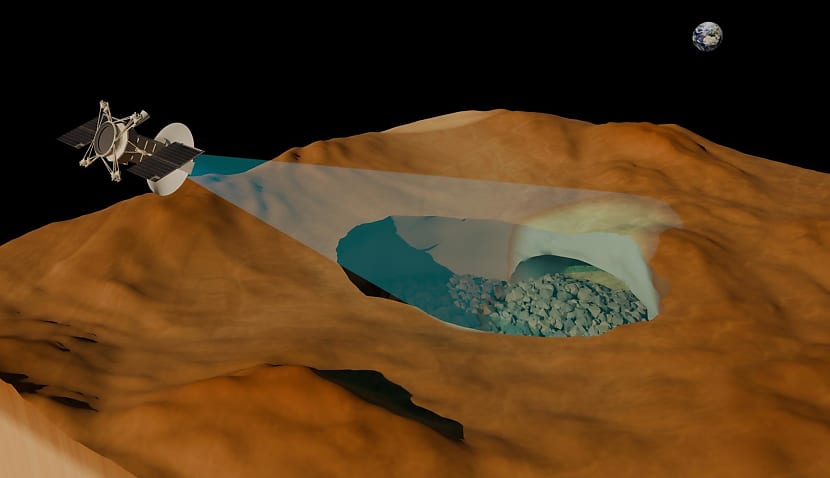
The University of Trento has demonstrated the existence of an empty lava tube in the depths of Venus – a planet whose surface and geology have been largely shaped by volcanic processes – in a study based on radar data collected by NASA’s Magellan mission and published in Nature Communications.
Traces of volcanic activity, such as lava tubes, have been found on Mars and the moon. The cave was identified through radar data analysis as part of a project funded by the Italian Space Agency.
“Our knowledge of Venus is still limited, and until now we have never had the opportunity to directly observe processes occurring beneath the surface of Earth’s twin planet,” according to Lorenzo Bruzzone, coordinator of the research, full professor of telecommunications and head of the Remote Sensing Laboratory at the Department of Information Engineering and Computer Science of the University of Trento.
“The identification of a volcanic cavity is therefore of particular importance, as it allows us to validate theories that for many years have only hypothesized their existence.
“This discovery contributes to a deeper understanding of the processes that have shaped Venus’ evolution and opens new perspectives for the study of the planet.”
Lava tubes form underground and these caves usually remain hidden and can only be spotted when part of their roof collapses, creating a pit visible on the planet’s surface.
These collapses may reveal both the presence of a lava tube and a possible entrance to it. On Venus, the search is even more challenging since the planet is covered by thick clouds that block direct views of the surface with standard cameras, forcing scientists to rely on radar images.
Between 1990 and 1992, a synthetic aperture radar – an instrument aboard NASA’s Magellan spacecraft – mapped the surface of Venus.
“We analysed Magellan’s radar images where there are signs of localised surface collapses using an imaging technique that we have developed to detect and characterise underground conduits near skylights,” according to Bruzzone.
“Our analyses revealed the existence of a large subsurface conduit in the region of Nyx Mons, the area named after the Greek goddess of the night.
“We interpret the structure as a possible lava tube (pyroduct), with an estimated diameter of approximately one kilometre, a roof thickness of at least 150 metres and an empty void deep of no less than 375 metres.”
The lava tube that has been identified appears to be wider and taller than those seen on Earth or predicted for Mars. This is not surprising, since Venus has lava channels that are larger and longer than those observed on other planets.
 Want to see more stories from trusted news sources?
Make Space Connect a preferred news source on Google.
