


The project, led by the University of Southern Queensland and funded by the iLAuNCH Trailblazer, sends two compact greenhouse payloads into orbit to study plant growth in microgravity using advanced imaging and artificial intelligence.
Project lead Associate Professor Cheryl McCarthy and her team travelled to the United States for the lift-off.
The experiment will use camera systems to continuously monitor plant growth on the ISS, capturing daily imagery that will be analysed to detect plant stress before it becomes visible to the human eye.
One plant chamber is designed to support healthy growth conditions and the other to intentionally induce stress, allowing researchers to compare growth patterns in real time.
“In this project, we are sending two small greenhouses to the International Space Station which contain plants, and we are going to use cameras to monitor their growth,” McCarthy said.
The launch follows months of extensive ground testing, safety reviews and documentation to meet the strict requirements for payloads flown to the ISS. The team has conducted multiple full practice runs of the experiment using the same components that will now be sent to space.
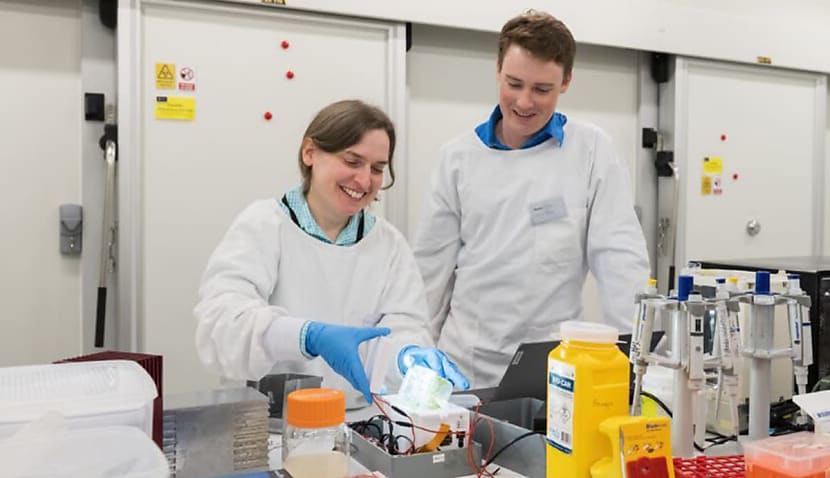
Prior to launch, the team finalised the experiment by sterilising the plant chambers, loading seeds and growth media, sealing the payload and handing it over for integration prior to launch.
“We have had to do months and months of ground testing for this experiment to send it to space, and everything needs to meet very stringent safety requirements before it can fly,” McCarthy said.
Understanding how to grow plants reliably in space is critical for future long-duration and deep-space missions, where plants are expected to play a role not only in food production but also in materials and medical manufacturing.
The technology being tested also has strong applications on Earth, particularly in remote or automated agricultural environments. By combining machine vision, sensors and AI-driven analysis, the system could enable plants to be monitored and managed without constant human oversight.
The project is funded by the iLAuNCH Trailblazer and led by UniSQ in collaboration with international and industry partners. Axiom Space (USA) provides spaceflight and payload expertise, while Yuri Gravity (Germany) has supported experiment design, electronics manufacturing and launch logistics. Australian agricultural business Medicinal Harvest has supported ground-based trials of the technology.
The mission represents a significant step forward in Australia’s capability to design, test and deliver complex payloads for space, while creating technologies with real-world benefits back on Earth.
 Want to see more stories from trusted news sources?
Make Space Connect a preferred news source on Google.