


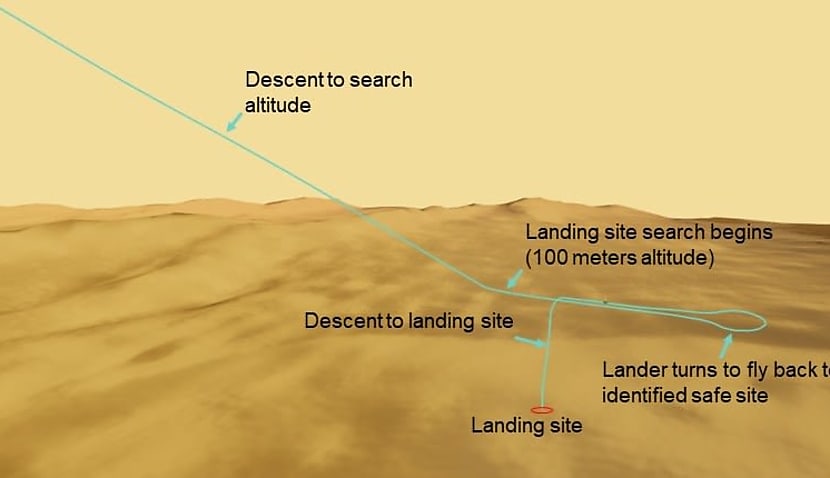
Separated from its protective backshell, NASA’s Dragonfly rotorcraft is expected to autonomously speed over the sand dunes of Titan while scanning the terrain below, searching for a safe place to land.
When Dragonfly discovers a safe site, it will turn, descend and land at the selected location, touching down for the first time on the surface of Saturn’s largest moon, according to the test undertaken via computer testbed at the Johns Hopkins Applied Physics Laboratory in Laurel, Maryland.
Dragonfly is scheduled to launch no earlier than 2028 for a six-year voyage to Saturn’s moon Titan, where it will spend three years flying from location to location to explore a range of sites to study the chemistry, geology and atmosphere of the Earth-like moon and ultimately advance our understanding of life’s chemical origins.
“The cool thing about first flight is that it’s our most challenging flight,” said Zach Putnam, Dragonfly mobility subsystem lead engineer at APL.
“It uses every piece of flight sensor hardware on the lander.”
The recent test brought together flight software and avionics with simulated data input from the sensors Dragonfly will use at Titan, including its newly installed navigation cameras, inertial measurement units and lidar system.
The team generated simulated terrain for the lidar and created, in real time, the images Dragonfly’s navigation cameras would see. A custom camera emulator used graphics-processing units to render each simulated Titan scene in roughly the same 20 to 70-milliseconds exposure times Dragonfly’s cameras will use during flight.
The team plans to run first flight on Dragonfly’s actual flight system, not a testbed, using the rotorcraft’s avionics. Engineers also will test other flight profiles and deliberately introduce faults to make sure Dragonfly can respond autonomously if something goes wrong.
“That autonomy is essential at Titan, where Dragonfly will have to fly without real-time help from Earth,” Putnam said.
“Everything we do on Titan has to happen autonomously.”
Before Dragonfly can make that first flight on Titan, it has to shift into position to be able to fly. Testing is also underway to ensure that the mechanisms handling that critical step will lower the rotorcraft below the entry system’s backshell, where it can safely start its rotors prior to separation from the entry system and begin its final descent to Titan’s surface.
 Want to see more stories from trusted news sources?
Make Space Connect a preferred news source on Google.
