


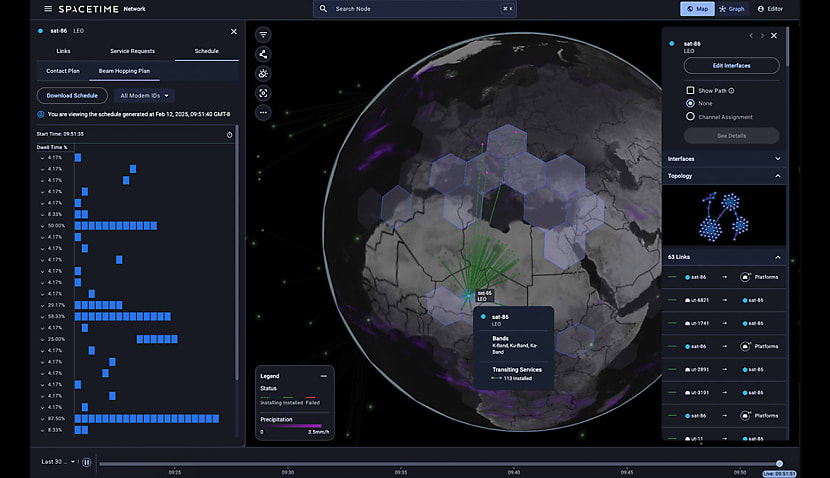
The Series B funding round was led by Battery Ventures and J2 Ventures, with additional investment from DYNE and other backers. The capital will support global deployment of Aalyria’s Spacetime network orchestration software and Tightbeam laser communications terminals.
Founded in 2021 using technology originally developed at Google and Lawrence Livermore National Laboratory, Aalyria aims to transform space communications by linking satellites, aircraft, ships and ground infrastructure into unified, self-optimising networks.
Chief executive Chris Taylor said the company was building a “communications and networking layer” capable of coordinating thousands of independent systems in real time, improving reliability, security and performance across commercial and military space operations.
Unlike traditional broadcast communications, Aalyria’s systems rely on tightly focused directional signals and laser links to transmit data faster and more securely. Its Spacetime platform continuously adjusts network connections to account for satellite movement, weather disruption and shifting operational priorities.
The technology is already being integrated into major satellite programs, including the Lightspeed low-Earth orbit constellation being developed by Canadian operator Telesat. Aalyria’s software will help manage data routing, spectrum allocation and link performance across the global network.
The company also secured partnerships with key aerospace and defence organisations, including Airbus, NASA and the European Space Agency, positioning it as a critical enabler of next-generation space infrastructure.
Investors said Aalyria’s combination of artificial intelligence-driven network orchestration and high-speed optical communications addresses one of the biggest challenges facing the rapidly expanding space economy: managing tens of thousands of satellites and exponentially growing data volumes.
As global reliance on satellite networks grows across commercial, civil and defence sectors, Aalyria is positioning itself to deliver the resilient, adaptive communications architecture needed to support the new space age.
 Want to see more stories from trusted news sources?
Make Space Connect a preferred news source on Google.