


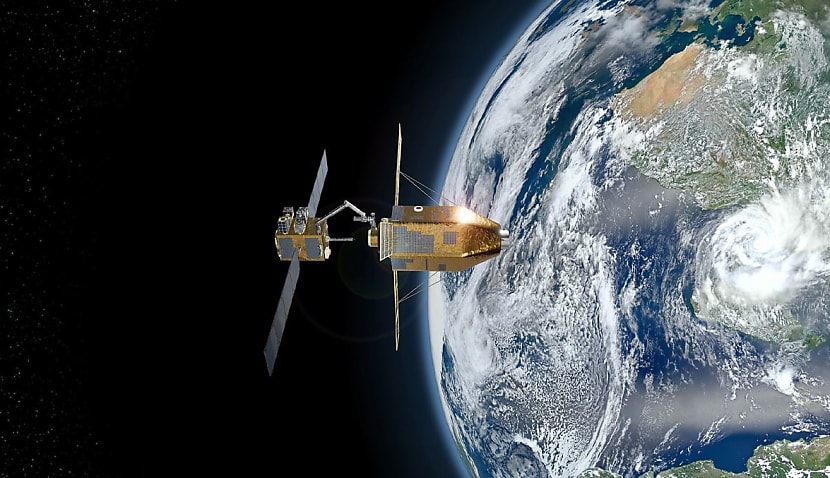
The contract forms part of the European Commission’s In-Space Operations and Services (ISOS) program, which aims to demonstrate advanced orbital servicing technologies by 2030 and lay the foundations for a permanent European infrastructure capable of supporting and maintaining satellites already operating in space.
Under the €12 million European Robotic Orbital Support Services – Servicing Component (EROSS SC) contract, Thales Alenia Space and its industry partners will develop one of two spacecraft intended to demonstrate autonomous rendezvous, robotic manipulation and satellite servicing operations in orbit.
Bertrand Denis, vice president observation, science and exploration at Thales Alenia Space in France, said: “The future of on-orbit operations missions in Europe is promising, as they will revolutionise the way we manage and maintain our space assets. These missions will not only enable satellite life extension in orbit but will also play a crucial role in mitigating space debris, ensuring a safer and more sustainable space environment for future generations.”
The spacecraft will test technologies required for future orbital servicing missions, including satellite approach and docking, capture operations, refuelling and payload exchange.
These capabilities are increasingly viewed as critical as governments and commercial operators seek to extend the operational life of expensive satellites while reducing the growing threat posed by space debris.
The demonstration mission is scheduled to form part of the broader ISOS program in 2030. During the mission, the spacecraft is expected to capture a defunct satellite and guide it into a controlled atmospheric re-entry, preventing it from remaining in orbit as hazardous debris.
A second spacecraft, known as SCOPE, will be developed under a separate contract led by Leonardo, with support from Thales Alenia Space’s Italian operations. The two spacecraft will together contribute to Europe’s first large-scale demonstration of robotic on-orbit servicing technologies.
Industry analysts view the project as part of a broader shift in how satellites are designed and operated. Rather than being launched and left to operate until failure, future spacecraft could be serviced, upgraded and refuelled in orbit, potentially extending mission lifespans and reducing replacement costs.
The EROSS SC consortium brings together companies and research organisations from across Europe. Participants include the Robotics and Mechatronics Centre of the German Aerospace Center and KINETIK Space in Germany, Space Applications Services in Belgium, Sener Aeroespacial in Spain, PIAP Space in Poland, SINTEF in Norway, and several other specialist firms contributing robotics, software, vision systems and spacecraft servicing technologies.
The project reflects growing international efforts to address the increasing congestion of Earth’s orbital environment. With thousands of active satellites now operating in orbit and large constellations continuing to expand, governments and industry are investing heavily in technologies that can both extend satellite lifetimes and help manage orbital debris.
“We are honoured that the European Commission has entrusted Thales Alenia Space and its partners to participate in the ambitious ISOS program aimed at demonstrating the European industry’s ability to develop on-orbit services,” Denis said.
If successful, the ISOS mission could establish Europe as a significant player in the emerging market for on-orbit servicing, maintenance and debris-removal operations, a sector expected to become increasingly important as space infrastructure becomes more complex and economically valuable.
 Want to see more stories from trusted news sources?
Make Space Connect a preferred news source on Google.