


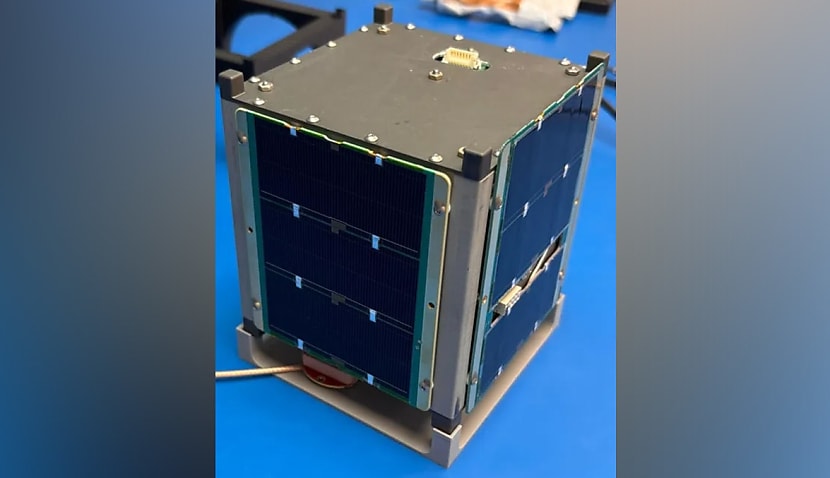
The company’s BOHR (Betavoltaic Orbital High-Reliability) spacecraft, launched aboard the SpaceX Transporter-17 mission, is also believed to be the first CubeSat to incorporate a nuclear power system, paving the way for a new generation of spacecraft capable of operating for extended periods without relying solely on sunlight.
Rather than replacing traditional solar arrays, the mission is designed to demonstrate City Labs’ proprietary NanoTritium betavoltaic technology as a dedicated power source for onboard payloads.
While the satellite itself continues to use conventional solar power to operate its core systems, the nuclear-powered payload will validate the ability to provide continuous electrical power regardless of lighting conditions.
The demonstration has significant implications for future space missions operating in environments where solar energy is either limited or unavailable, including deep-space exploration, permanently shadowed regions of the moon and long-endurance autonomous sensor networks.
City Labs chief executive Peter Cabauy described the launch as a watershed moment for commercial nuclear technology in space.
“This is a historic step for commercial nuclear power in space,” Cabauy said.
“BOHR demonstrates that safe, compact and regulatory-approved nuclear power systems are ready for routine commercial deployment. This capability enables persistent, always-on payload operations that are not constrained by sunlight or battery life.”
The mission comes as interest in alternative spacecraft power systems accelerates alongside NASA’s Artemis lunar exploration program and growing commercial ambitions beyond low-Earth orbit.
Future lunar infrastructure, deep-space probes and long-duration scientific missions are expected to require reliable power sources capable of operating through extended periods of darkness or in permanently shadowed environments.
Beyond its technological significance, the BOHR mission also represents an important regulatory milestone for the commercial space sector.
According to City Labs, the spacecraft became the first commercial nuclear-powered payload to complete the US Federal Aviation Administration’s (FAA) launch approval process established under National Security Presidential Memorandum-20 for missions carrying nuclear material.
The company received payload authorisation from the FAA on 30 September 2025 following a comprehensive launch safety assessment. The regulatory review included independent technical validation by Sandia National Laboratories, which supported the approval process.
City Labs said its tritium-powered NanoTritium technology operates at extremely low radiation levels and has been specifically engineered for safe handling, transport and integration into existing commercial launch operations.
The BOHR mission is intended to serve as a pathfinder for future civil, scientific and national security spacecraft requiring reliable, maintenance-free electrical power over extended operational lifetimes.
The program builds on years of private investment by City Labs and has also received support through a range of US government research initiatives, including contracts with the Air Force Research Laboratory, AFWERX, NASA and SpaceWERX, alongside funding through the Operational Energy Capability Improvement Fund.
Headquartered in Florida, City Labs develops advanced tritium-based nuclear micropower systems for medical, industrial and aerospace applications. Its NanoTritium technology is designed to deliver long-life, maintenance-free power in environments where conventional batteries or solar energy are impractical.
 Want to see more stories from trusted news sources?
Make Space Connect a preferred news source on Google.