


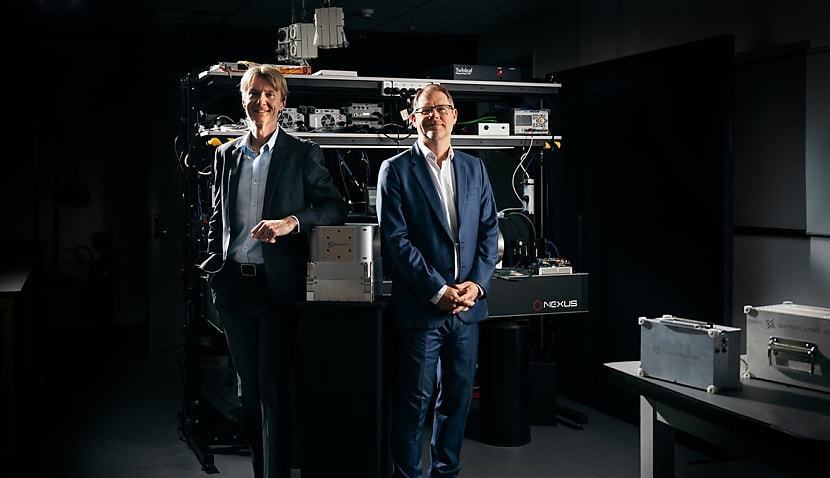
Australia has recorded a world first in space-based quantum technology, with Adelaide company QuantX Labs successfully commissioning and operating an optical frequency comb in orbit for the first time.
Supported by the Australian Space Agency through its Moon to Mars Demonstrator Program, the mission marks a major milestone in QuantX Labs’ KAIROS program, which is developing next-generation optical atomic clocks capable of delivering unprecedented precision for positioning, navigation, and timing (PNT) applications.
Launched on 30 March aboard French space logistics company Exotrail’s spacevan™ orbital transfer vehicle as part of SpaceX’s Transporter-16 rideshare mission from California’s Vandenberg Space Force Base, the Australian-developed payload has now been successfully commissioned in orbit after surviving launch and deployment.
QuantX Labs CEO and co-founder Professor Andre Luiten said the achievement validated years of research and engineering while demonstrating Australia’s growing leadership in quantum-enabled space technologies.
“The successful commissioning of our optical frequency comb in space is a landmark achievement for QuantX Labs and for Australia,” Professor Luiten said.
“This mission demonstrates that advanced Australian quantum technologies can operate successfully in orbit and paves the way for a new generation of precision timing systems that will support navigation, communications, Earth observation and future space missions.”
Optical frequency combs, recognised with the 2005 Nobel prize in physics, are a critical component of optical atomic clocks. They convert ultra-stable optical signals into electronic timing information, enabling dramatically more accurate timing than existing technologies and forming the foundation for future space-based PNT services.
The successful demonstration also provides valuable flight heritage for the technology and significantly reduces technical risk ahead of QuantX Labs’ planned launch of a complete optical atomic clock payload in 2027.
“We have now proven the performance of one of the most important building blocks of an optical atomic clock in the space environment,” Professor Luiten said.
“We are already progressing towards a full optical atomic clock payload, with our Proto-Flight Model currently undergoing environmental qualification testing ahead of a planned launch in 2027.”
Australian Space Agency head Enrico Palermo said the mission reflected Australia’s longstanding strengths in quantum science and precision timing.
“The Australian Space Agency is proud to have invested in the quantum clock technology developed by QuantX Labs, building on Australia’s rich heritage in quantum and accurate timing technologies,” Palermo said.
He said the mission brought the company significantly closer to delivering advanced sovereign timing capabilities designed to enhance the positioning, navigation, and timing services relied upon by Australians every day.
Beyond space exploration, ultra-precise timing technologies underpin critical national infrastructure, including communications networks, transport systems, financial services, and defence capabilities. By successfully operating an optical frequency comb in orbit, QuantX Labs has not only achieved a world first but has also positioned Australia at the forefront of the next generation of quantum-enabled space technology.
 Want to see more stories from trusted news sources?
Make Space Connect a preferred news source on Google.