


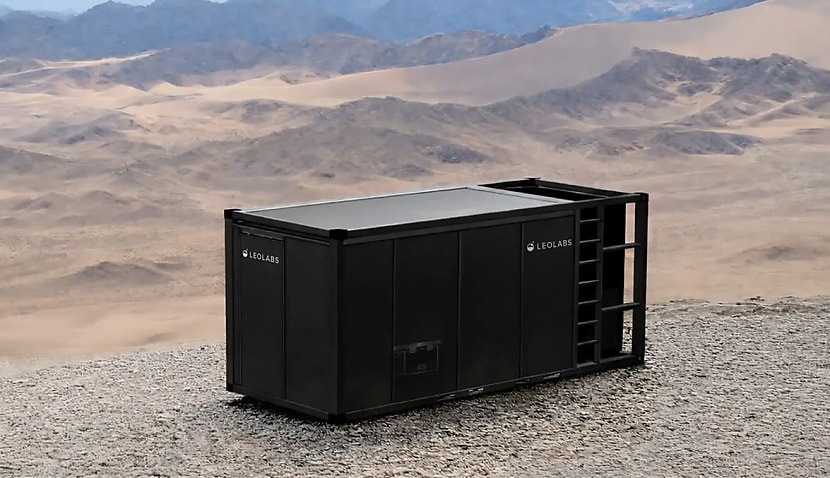
US space technology company LeoLabs has been awarded a US$20.68 million ($28.81 million) prototype other transaction agreement by the US Space Force (USSF) to deliver a modified version of its Scout radar system.
The contract will allow LeoLabs to adapt its containerised, transportable 3D search radar for new national security missions as the US military seeks more resilient and distributed sensing capabilities.
LeoLabs said the award reflects the growing need to track increasingly fast and manoeuvrable threats using a network of sensors that can be rapidly deployed, repositioned and scaled.
The Scout family is designed to provide additional sensing capacity without relying solely on large, fixed radar installations. Its transportable architecture allows systems to be deployed where and when additional coverage is required, strengthening battlespace awareness and resilience.
The latest award follows LeoLabs’ deployment earlier this year of its first operational Scout system, optimised for space domain awareness. The company has also been developing the platform for missions including foreign launch detection and tracking, with future applications extending into missile warning and broader multi-domain surveillance.
LeoLabs chief executive Tony Frazier said the contract demonstrated how commercially developed technology could be rapidly adapted to emerging military requirements.
“Together, we’re demonstrating how proven commercial technology can accelerate the delivery of new capabilities for US defence missions.”
The contract also highlighted a broader shift in US defence acquisition towards commercially developed systems that can be demonstrated and fielded faster than traditional bespoke programs.
By combining LeoLabs’ existing radar technology with a distributed deployment model, the Scout system is intended to complement larger sensing systems and provide additional coverage in contested or rapidly changing environments.
LeoLabs has increasingly targeted the US and allied defence market, with the company reporting more than US$60 million ($83.6 million) in contract awards during 2025 and significant growth in US government business. Its radar network currently supports a commercial catalogue tracking more than 26,000 objects in low-Earth orbit.
The latest USSF investment provides another pathway for that commercial technology to transition into operational military applications.
For the Space Force, the program offers an opportunity to test whether rapidly deployable radar can improve persistent tracking and sensing in a more distributed architecture. For LeoLabs, it strengthens the company’s position at the intersection of commercial space-domain awareness, missile tracking and next-generation defence sensing.
 Want to see more stories from trusted news sources?
Make Space Connect a preferred news source on Google.